


Schroeter Portraits
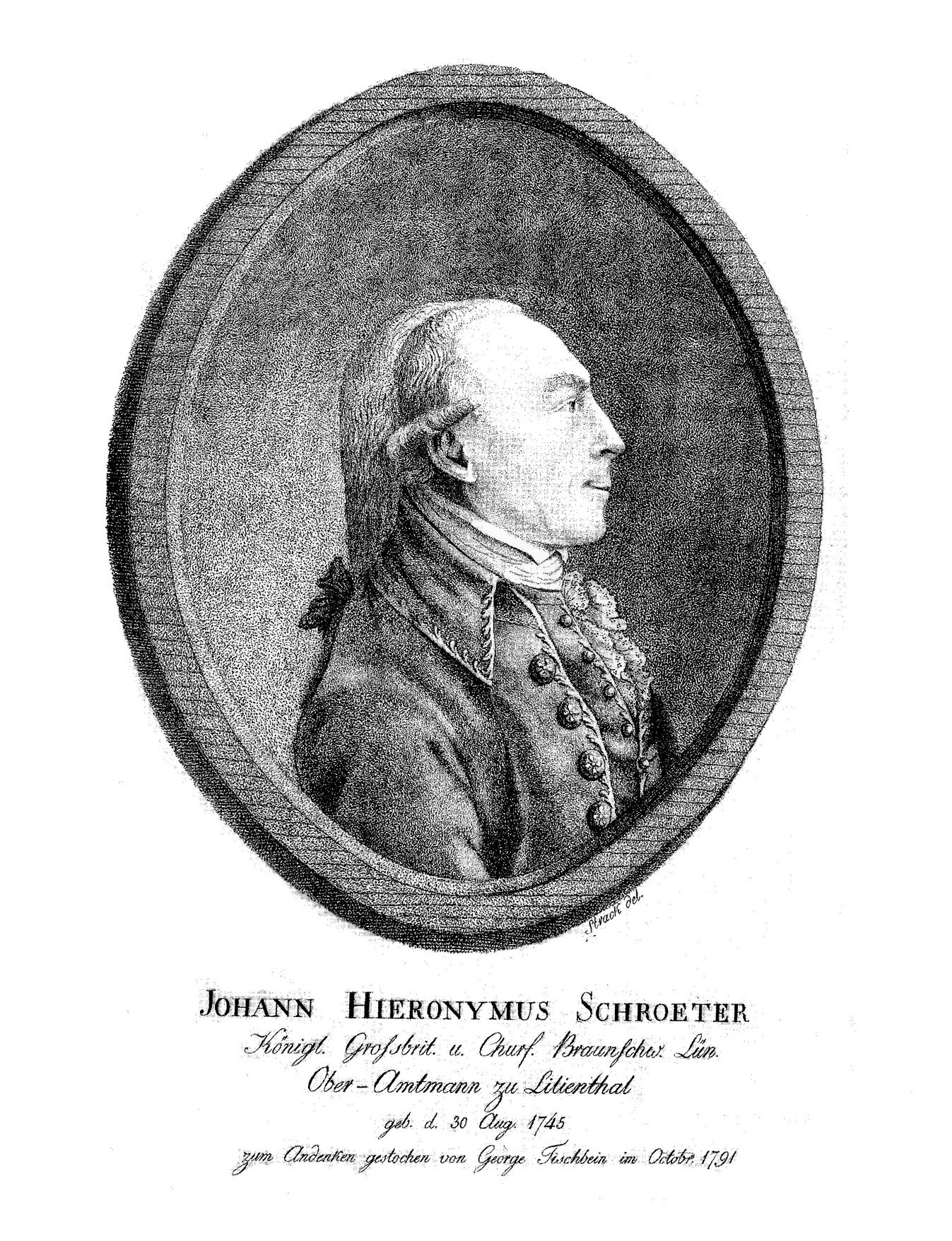
Schroeter Portrait by Georg Tischbein, 1791
So far, two portraits of the astronomer and chief administrator from Lilienthal were known:
The most well-known portrait, created by Georg Tischbein in 1791, depicts the right side of his face in profile. Additionally, there is an undated portrait by an unknown copper engraver, which shows the left side of his face.
In 2001, the author acquired a similar portrait from an antiquarian bookstore, which he classified as unknown. It had been stored in the archive for several years alongside other portraits of Olbers and Bessel, old maps, and engravings of celestial objects from around the turn of the century.
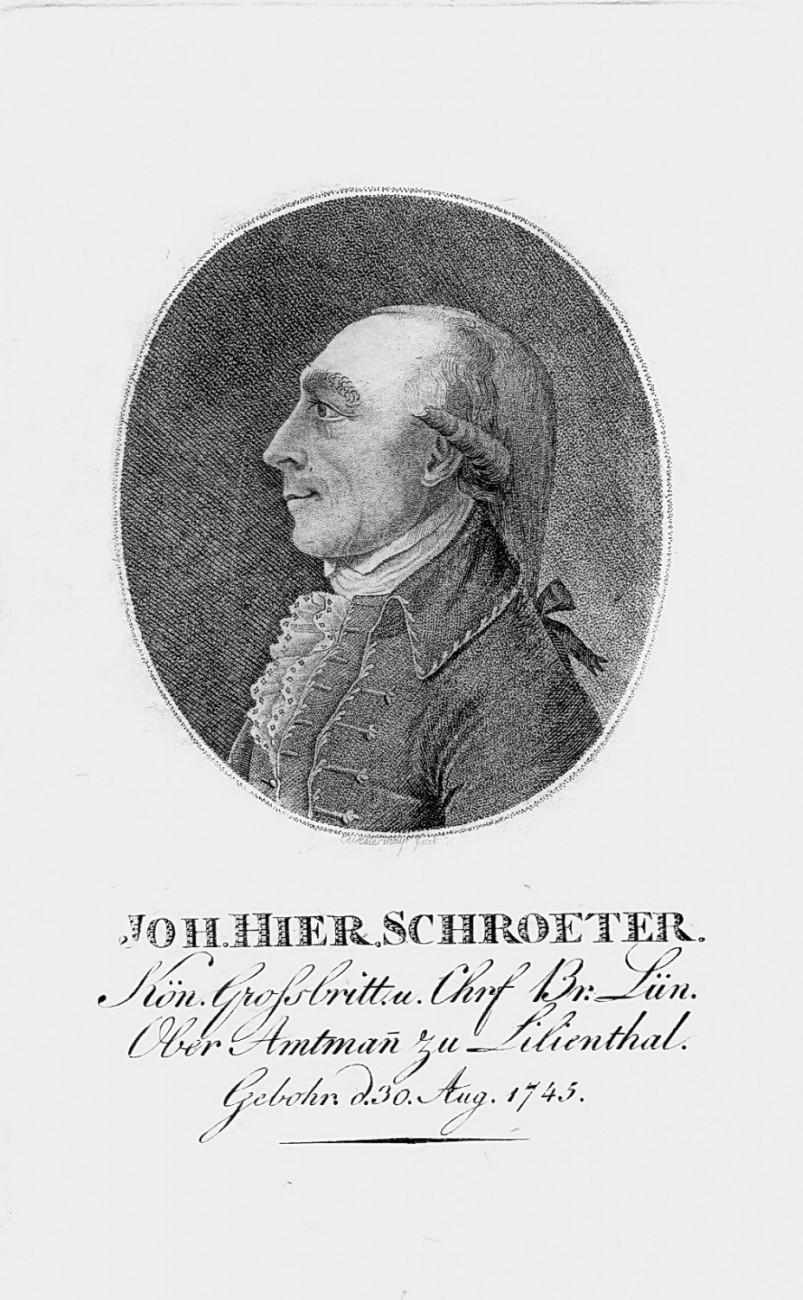
Schroeter Portrait by Westermayr
Since around 2011, this engraving has appeared as a cropped version on WIKIPEDIA. However, it was likely not available during Dieter Gerdes’ research on Schroeter and the Lilienthal Observatory in the 1990s.
With the revival of the Telescopium Lilienthal project after a nearly ten-year hiatus, the portrait has once again become relevant for research into its author and the time of its creation.
Barely visible to the naked eye, the scanned image revealed the artist who brought the great astronomer to life on paper after some digital image processing.
The inscription beneath the center of the image—barely a millimeter high in reality, delicately engraved with a fine needle—revealed, with great effort, something resembling the name Westermayr.
The internet once again made it possible:
Conrad Westermayr (1765–1834) was a German painter and copper engraver from Hanau. Initially trained as a goldsmith, he later studied at the Zeichenakademie Kassel under—unsurprisingly—Jacob Heinrich Tischbein.
The Tischbein family was widely known at the time, and even Goethe had enlisted one of them as a travel painter to indulge in dolce vita in Italy. A branch of this large family extended as far as Bremen, and Schroeter’s lunar engraver, Georg Tischbein, also created a portrait of our lunar researcher.
In Weimar, Westermayr learned copper engraving and worked for the legendary Bertuch publishing house. From Weimar, he moved to Dresden, then returned to Weimar where he got married. Conrad rose in his career, becoming a professor at the Academy in Hanau and later its director. He painted battles from the Napoleonic Wars and a series of beautiful city views.
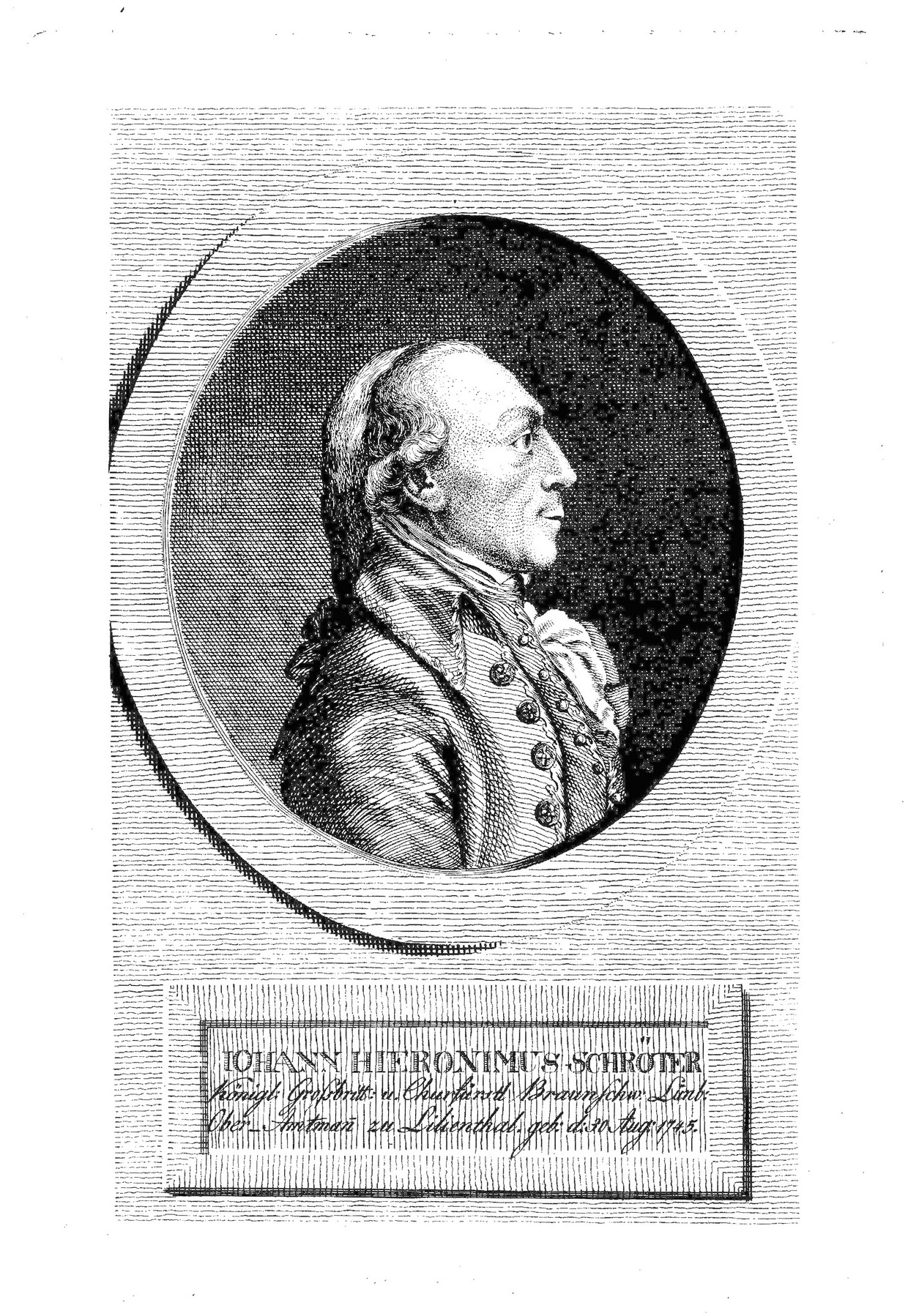
Schroeter Portrait, Author and Date unknown
The present portrait has a size of approximately 14 x 8 cm. According to an expert evaluation, it is an exceptionally fine piece of work with a wide range of gray tones. The copper engraving can be dated to the years between 1795 and 1800. It is highly likely to be an original print, as lithographs for reproduction were not yet common at the time.
Upon closer examination of the portrait initially classified as lacking provenance, its signature was also identified! It is evidently a copy of the Westermayr portrait, though without the signature text that appears in the original.
The third portrait, also acquired in its original form from an antiquarian bookstore, does not bear the artist’s signature.
In the depiction, it is similar to the Tischbein portrait, but shows some variations in Schroeter’s clothing and hairstyle. The signature text is shortened and made less clear due to vertical shading. It could be a copy of the Tischbein portrait, but with a decline in artistic quality.
H.J. Leue