


The story of my life.
My Name is Johann Hieronymus Schroeter. As the son of the lawyer Paul Christoph Schroeter and his wife, Regina Sophia, I was born on August 30, 1745, in Erfurt. I was the youngest of three children and, due to my frail health, was baptized early the following morning.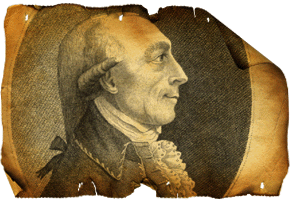
The renowned Erfurt physician and professor Johann Hieronymus Kniphof was my godfather and gave me his name as a legacy for my life. Starting at the age of six, I attended the school of the Predigerkirche and in the spring of 1758 transferred to the Erfurt Council Gymnasium. My father passed away when I was twelve years old, leaving little to his children; however, he did leave us virtues such as perseverance, precision in mechanical work, and a profound love for music and astronomy. Later, I enrolled as a theology student at the University of Erfurt. After five semesters, I continued my education—this time in the field of jurisprudence—at the University of Göttingen (Georgia-Augusta) and was enrolled free of charge “ob paupertatem gratis” (due to poverty). My love for astronomy was especially awakened and nurtured by professors G. A. Kästner and G. C. Lichtenberg, as well as through observations at the university observatory in Göttingen.
After passing all state examinations and spending 10 years in administrative service in the Electorate of Hanover, my solid legal knowledge allowed me to secure a position in Lilienthal on May 1, 1782. I had already applied for this role in 1781, hoping that the small office on the edge of the “Teufelsmoor” would provide me with sufficient time for astronomical observations. My sister Elisabeth, thirteen years my senior, had managed my household in Erfurt and came with me to Lilienthal to continue doing so.
While today the administrative head of the Osterholz district is referred to with the uninspiring title “District Administrator,” my title was far more grandiose:
Royal British and Electoral Brunswick-Lüneburg Chief Administrative Officer of the Lilienthal Office in the Duchy of Bremen.
“Lilienthal was then a small village at the edge of the Teufelmoor. I was fortunate to find enough open space behind the monastery church, in the estate garden, to soon begin planning and building my own observatory. My good relationship with Wilhelm Herschel helped me acquire important optical parts, from which I made two fairly good reflector telescopes.”
In 1785, I finally had my first observatory in the official garden. It was a two-story
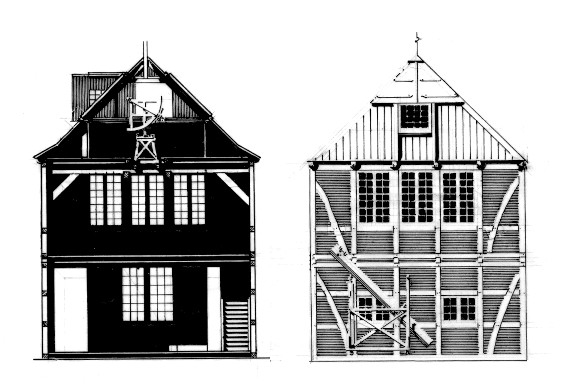 half-timbered which I named „Uranienlust“ in honor of the great Danish astronomer Tycho Brahe.
(Brahe had named his observatory “Uranienborg” on the Danish island of Hven)
I shared a close friendship with the esteemed physician and astronomer Dr. Matthias
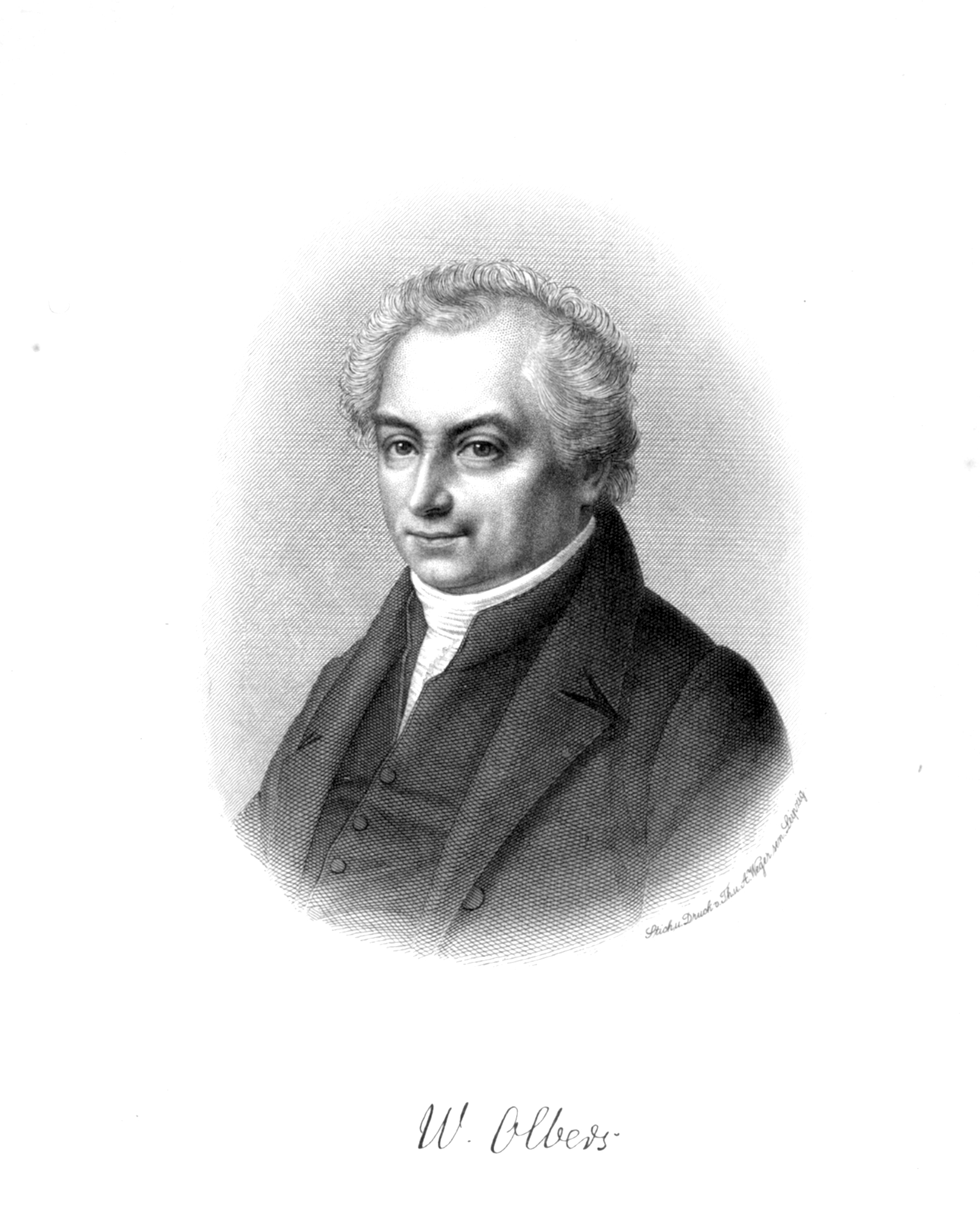 Wilhelm Olbers of Bremen, renowned for his expertise in calculating comet orbits. Lilienthal soon developed into a true center of astronomy with international significance
With all modesty, I may point out that Olbers and I provided key impetus for 19th-century astronomy. My studies on the Moon, Jupiter, and Venus were enthusiastically published by Johann Elert Bode, the editor of the Astronomisches Jahrbuch (Astronomical Yearbook) in Berlin. This led to the great honor of being elected to the “Akademie Nützlicher Wissenschaften zu Erfurt” on June 6, 1787, and shortly thereafter to the Royal Academy in Göttingen.
Five years later, in September 1792, I was especially pleased to be invited to the 400th-anniversary celebration of the University of Erfurt. This trip was particularly meaningful, as highlighted in the “Erfurter Gelehrten Zeitung” on October 3, 1792, regarding the events of September 19:
„On the third day, the procession, as on the previous day, proceeded from the house of the Rector Magnificus to the Collegium Anselminum, where 14 legal promotions took place. The Faculty of Law, along with the entire university, took the opportunity to honor their learned compatriot Johann Hieronymus Schroeter of Lilienthal—long celebrated as one of the foremost astronomical observers within and beyond Germany. As a token of high regard, they conferred upon him, unsolicited and free of charge, the degree of Doctor of Laws (Canon and Civil).“
I must also tell you that on June 11, 1786, a son was born to me from a union—though not legally recognized—of true Christian matrimony with Ahlke Lankenau of Lilienthal-Oberende. We baptized him Johann Friedrich.
This enabled me to employ Karl Ludwig Harding, who already had
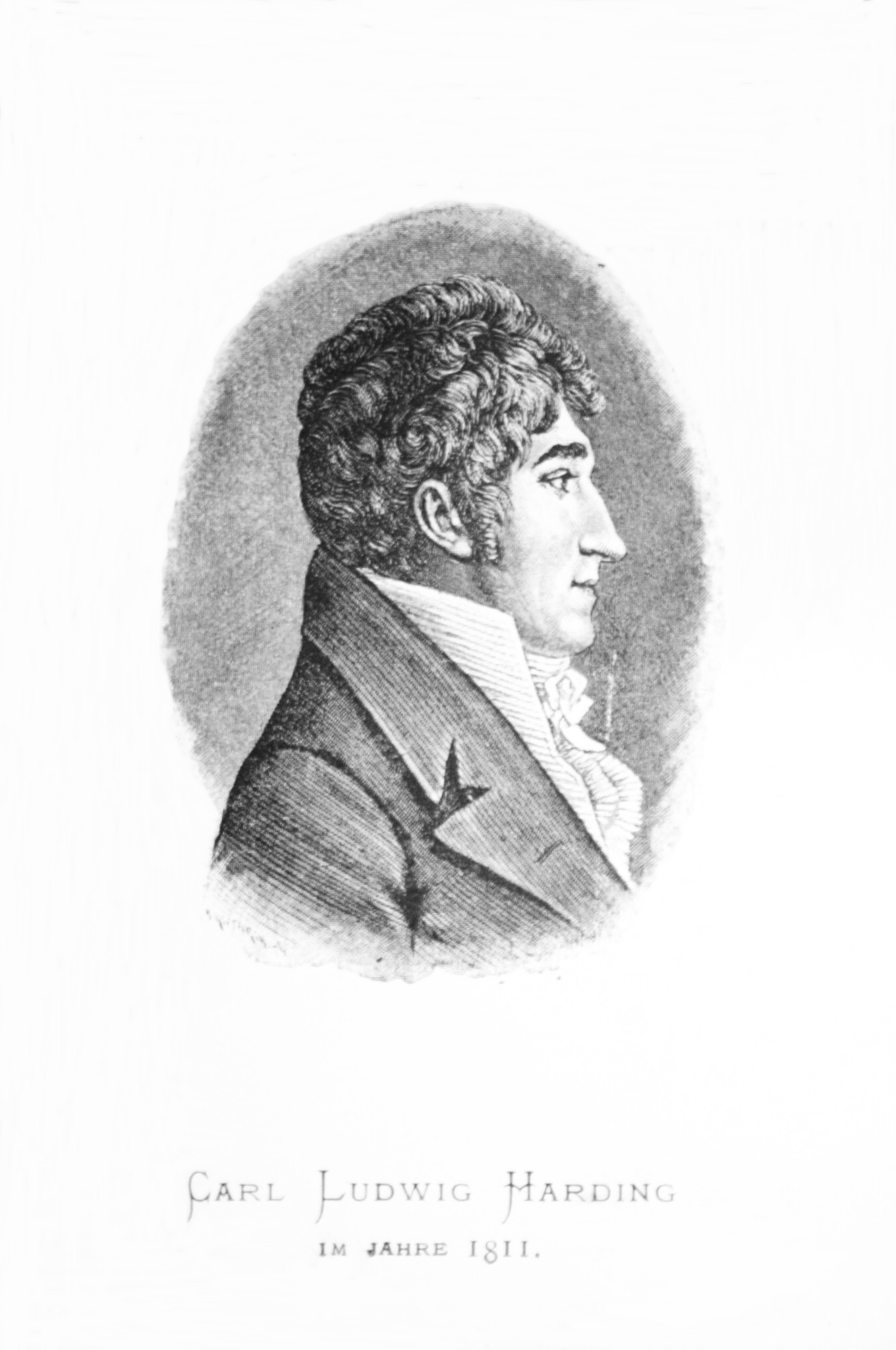 considerable astronomical knowledge, as both a tutor for my son and an assistant at the observatory. Harding would later discover the asteroid Juno at my observatory. When my son Johann Friedrich turned seven, I had managed, with years of savings and the assistance of the esteemed physics professor Gottlieb Friedrich Schrader of Kiel (who stayed with me for ten months), to complete my 27-foot telescope in spring 1793. This monumental instrument stood in a second observatory in the official garden, featuring a
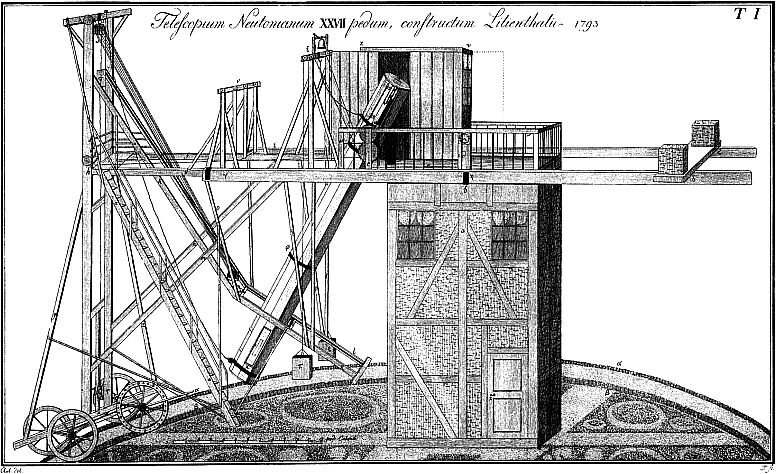 mirror with a 50 cm aperture and an 8.25 m focal length. “It was moved over the center of a rotating axis located in a tower building with a floor area of 4.0m x 4.0m and a height of 8.0m, rotating on a circle of 20m. The telescope itself was positioned at the bottom with pulleys, allowing it to be tilted to any angle and easily adjusted to any celestial position using a manually movable cart. The idea behind this construction, a quick scale with perfect weight compensation, made it effortlessly easy to move the telescope in any desired direction of the sky.”
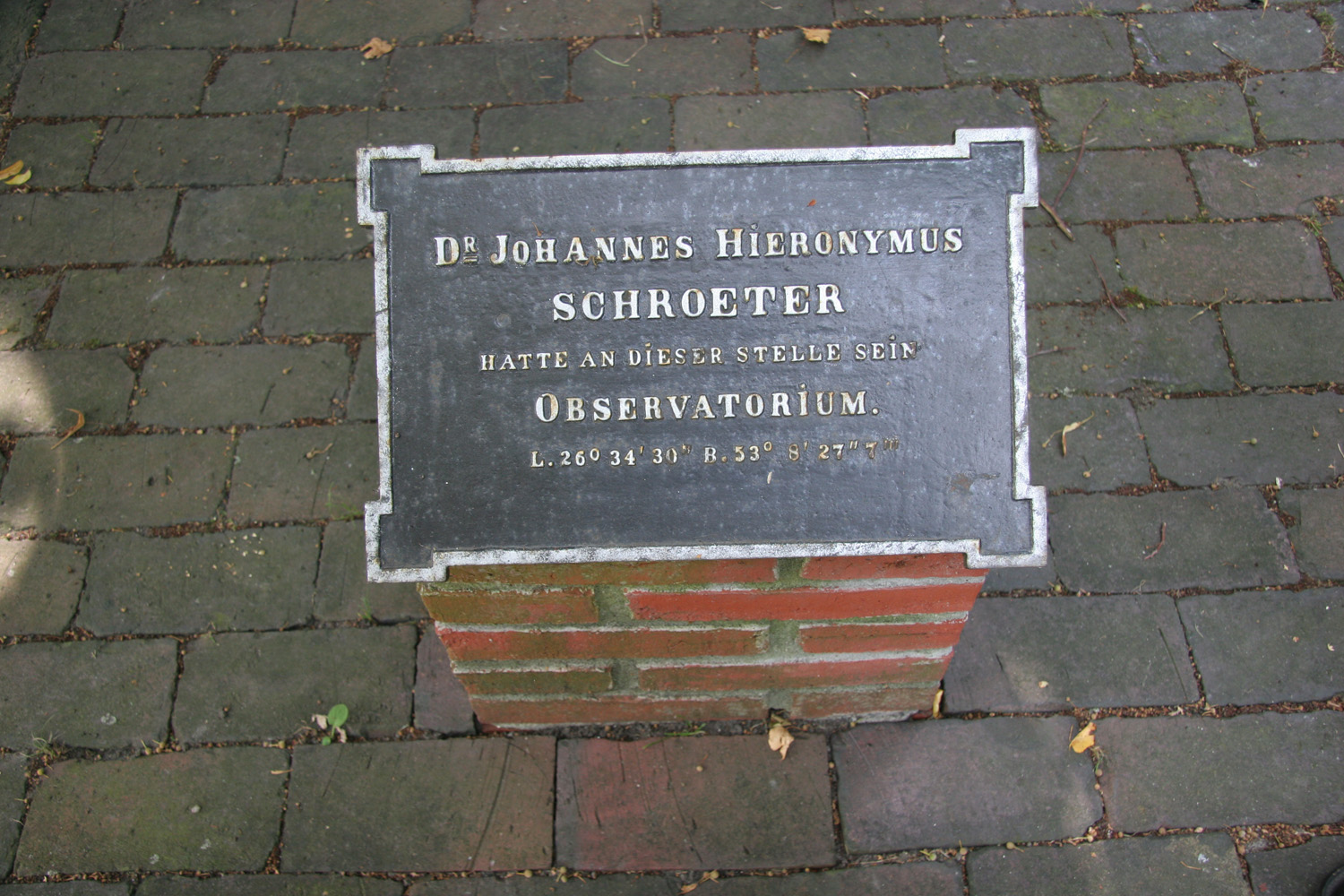
“It was the largest telescope on the European mainland, and the location of my Lilienthal Observatory, the only one in the Duchies of Bremen and Verden, was henceforth recorded in every international handbook for astronomy and navigation. The attention was global, and prominent visitors from all over Europe now frequently came to the small village of Wörpe.”
“By 1795, I had also completed my third observatory,
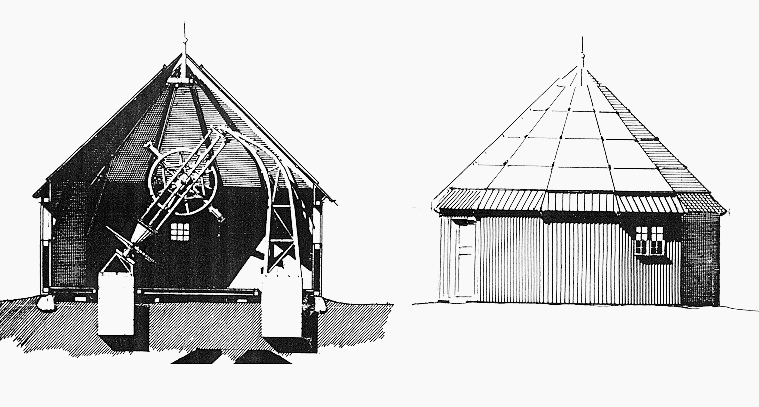 which I called the ‘Urania Temple.’ It was a round wooden structure with a diameter of 7.00 meters. The individual segments of the conical roof were hinged and could be opened. Many publications followed in the coming years, with scientific treatises on the lunar surface, the sun, the moons of Jupiter and Saturn, etc., which I shall not bore you with here. However, there is something special that I must tell you, my highly esteemed ladies and gentlemen, as it was of extraordinary significance not only for the history of astronomy in Lilienthal.”
“On September 20, 1800, the ‘Astronomical Society’ was founded at my observatory, with significant involvement from Franz Xaver von Zach from Gotha, Ferdinand Adolf von Ende from Celle, Senator Johann Gildemeister from Bremen, Wilhelm Olbers from Bremen, Karl Ludwig Harding, my assistant, born in Hamburg, and myself.
A society that still exists today and was something quite extraordinary in my time of many states in Europe. If you allow me to make a comparison, it was the first precursor to today’s European Community. This newly founded Lilienthal Society had the goal of discovering a planet suspected to exist between Mars and Jupiter but not yet discovered.
To achieve this goal, the twelve zodiac constellations, through which the planets move around the Sun during the course of a year, were assigned to 24 international astronomers, with the requirement to constantly monitor and record observations in search of any potential unknown planet. I was honored with the position of president, and Franz Xaver von Zach became the permanent secretary.
However, the most special highlight of the founding meeting was the visit of Prince Adolph Friedrich,
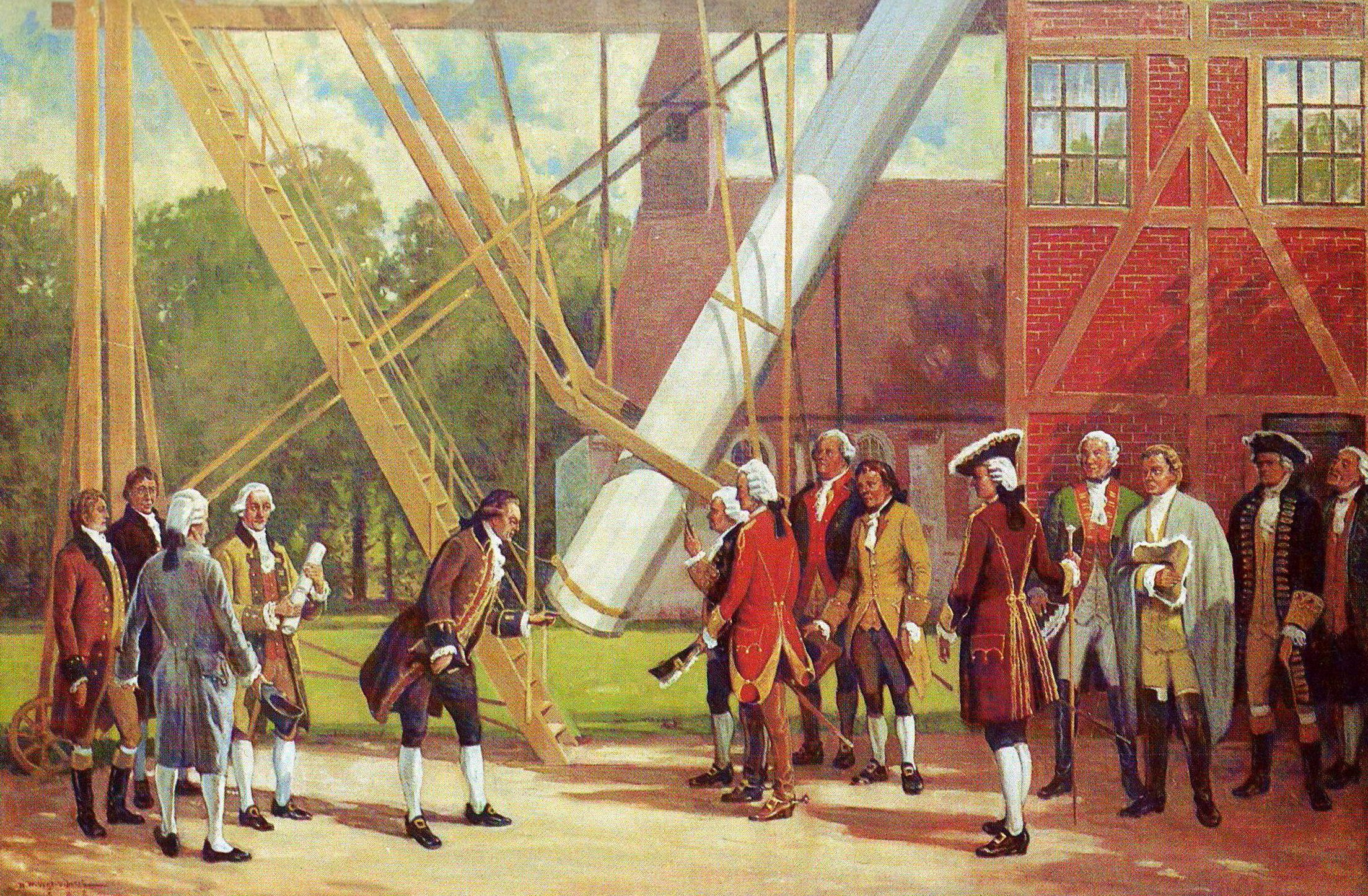 Son of King George III of England and Hanover, later the General Governor and Viceroy of the Hanoverian Territories, on this very day in Lilienthal.
Carl Friedrich Gauß, who was still in Braunschweig at the time, also joined our society in the autumn of 1801 and, along with Wilhelm Olbers, was appointed to the board three years later to handle foreign affairs.
The ‘Astronomical Society,’ with its 24 astronomers, all of whom were world-renowned, worked very successfully:
In January 1801, Piazzi in Palermo discovered the first new planet, Ceres. In 1802, Wilhelm Olbers in Bremen successfully explored Pallas. Harding, as I mentioned earlier, discovered Juno at the Lilienthal Observatory on September 2, 1804. Wilhelm Olbers then discovered the asteroid Vesta in 1807.
The four newly discovered celestial wanderers all orbited the Sun on similar paths, exactly where a planet had previously been suspected by us.
My highly esteemed readers, I have shared with you the story of my life, the development, and growing importance of the Lilienthal Observatory, all in a peaceful time. Now, I must read you a letter that marked the end of astronomical research in Lilienthal and signaled difficult times for everyone living in and around Lilienthal.
In 1807, the Kingdom of Westphalia was founded under Jérôme Bonaparte, the youngest brother of the French Emperor. However, the Elbe-Weser region, including Lilienthal, did not belong to it until 1810. It remained under the French occupation of General Mortier.
This general wrote the following letter, which reached me on December 7:”
To the Estates of Hanover:
Gentlemen!
I have taken possession of your land in the name of His Majesty the Emperor and King, my Most Gracious Lord. The public revenues of Hanover shall be collected, and justice shall be administered in His name. All existing state administrations shall remain as they are unless His Majesty the Emperor decides otherwise.
I appoint an Executive Commission consisting of three members: Messrs. Patje, Meding, and Münchhausen. This commission shall have the same responsibilities as the one established during my previous stay in Hanover. It shall report and take orders from the person to whom the Emperor entrusts the administration of Hanover.
Receive, gentlemen, the assurances of my highest esteem.
Mortier
At the headquarters in Hanover, November 12, 1806
This official notification of the French occupation also meant that a year later, I lost my office in Lilienthal, as it was incorporated into the Kingdom of Westphalia as a canton. The rest of my story is quickly told.
In April 1813, marauding French soldiers almost completely burned down Lilienthal. Although my observatories were largely spared from the fire, I had to watch—half-dressed in the night of April 21—as my entire personal property went up in smoke, except for my excellent private library, a small collection of valuable physical instruments, and some manuscripts and works published at my own expense.
My friend Wilhelm Olbers took me in, and I did not return to Lilienthal until I had somewhat recovered. Although I continued my duties as a judicial counselor and chief administrator in Lilienthal, I no longer had the strength to revive my observatories.
One day before completing my 70th year, the Almighty and
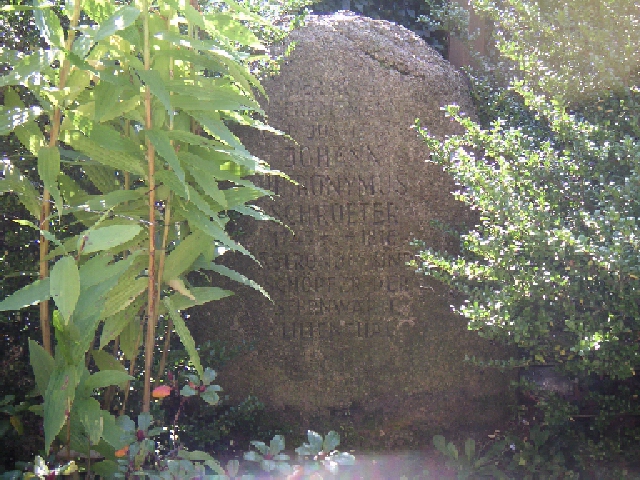 gracious God called me to Him on August 29, 1816.
And if you ever come to visit me at the west side of the monastery church in Lilienthal, please be quiet—and do not block my view of the stars.
My most esteemed and noble descendants, this is essentially my story.
In my time, there were many men like myself who had never studied mathematics, physics, or astronomy at universities, yet still achieved great scientific accomplishments in these fields. Let us think, for example, of Tobias Mayer, the first great astronomer in Göttingen and director of the old observatory; of Karl Ludwig Harding, my assistant, who was appointed professor of astronomy in 1805 and left Lilienthal for Göttingen to establish a new observatory there; of Wilhelm Olbers, an expert in cometary orbits and immortalized through Olbers’ Paradox; and of Friedrich Wilhelm Bessel, who was called directly from Lilienthal to Königsberg as a professor of astronomy and director of the observatory.
None of them had studied natural sciences or even astronomy in the way it is understood today.
Perhaps this is part of the reason they have been forgotten—but also what makes their achievements so admirable.
Lilienthal, April 2015
Klaus-Dieter Uhden (translated)