


From Schroeter’s “Fragmenten”
The drawings, the observation data, and the so-called conclusions—summaries by the author based on the description of extensive observations—were taken from Schroeter’s “Fragments.”
Example: Sun
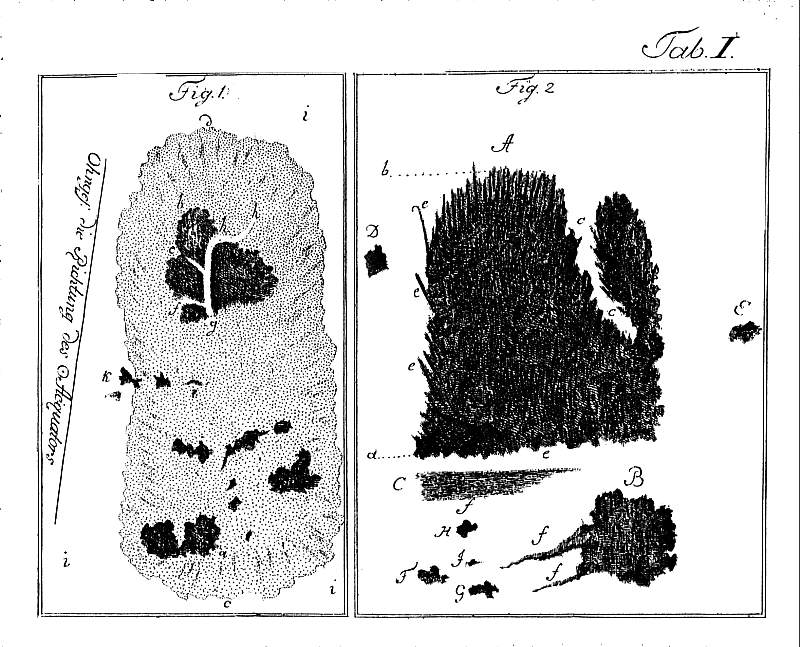
J.H. Schroeter’s observations of the Sun, similar to those of the Moon, span a long period of more than 15 years.
Starting in 1779 with a small 3-foot achromatic refractor, Schroeter increasingly used his reflecting telescopes to study sunspots and faculae.
Since the powerful instruments concentrated a lot of heat, which had to be mainly absorbed by a dense dimming glass at the eyepiece, solar observation was not entirely without danger. Several times, he reported that when a glass cracked, “the flash of the light cone shot into his eye.”
In addition to studying surface phenomena, J.H. Schroeter determined the diameter and rotation period of the Sun and recognized the crater-like depressions of sunspots (Wilson effect). He sought explanations for the “physical nature of its surface and light.” Although he doubted the hypothesis of the French astronomer De la Hire, which suggested that the Sun was a dark body surrounded by a luminous fluid, he could not entirely dismiss it.
Observation Instruments: (1 foot ≈ 30 cm focal length)
- 3-foot achromatic refractor (1779–1784)
- 4- and 7-foot reflectors based on Herschel’s design (from 1784 and 1786, respectively)
- 7- and 13-foot Newtonian reflectors by Schrader/Schroeter (from 1793)
- 10-foot refractor by Dollond
Co-observer of J.H. Schroeter:
- From Lilienthal: Karl Ludwig Harding
Observational Results:
- The Sun does not appear as a flat surface but as a sphere.
- The brightness of the solar disk decreases significantly towards the edge (limb darkening).
- There are spots and faculae on the Sun.
- The cores of sunspots (umbra) are dark to black (Tab. I – Fig. 2).
- Their edges exhibit a striped structure.
- Some spots have bright “light veins” (light bridges) (Tab. I – Fig. 1).
- Many spots are surrounded by a faint gray “light haze” (penumbra).
- Their outer edges are not sharply defined but appear streaked.
- Spots near the edge appear mountainous, like craters.
- Solar faculae are brighter than the surrounding solar surface.
- Faculae appear alone or near sunspots.
- Sunspots and faculae often change very rapidly.
- Spots tend to cluster in a zone around the solar equator.
- The Sun is not uniformly bright but appears “marbled” (granulation).
Conclusions:
- The Sun has an “atmosphere” that emits light (photosphere).
- Light is invisible and becomes perceptible only through reflection.
- Sunspots form due to the “layering of the light atmosphere” (stratification).
H.J. Leue (translated)
Example: Moon
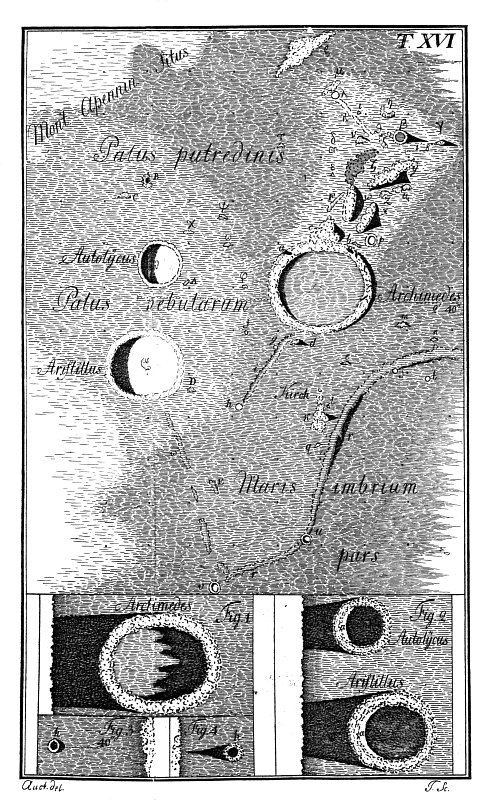
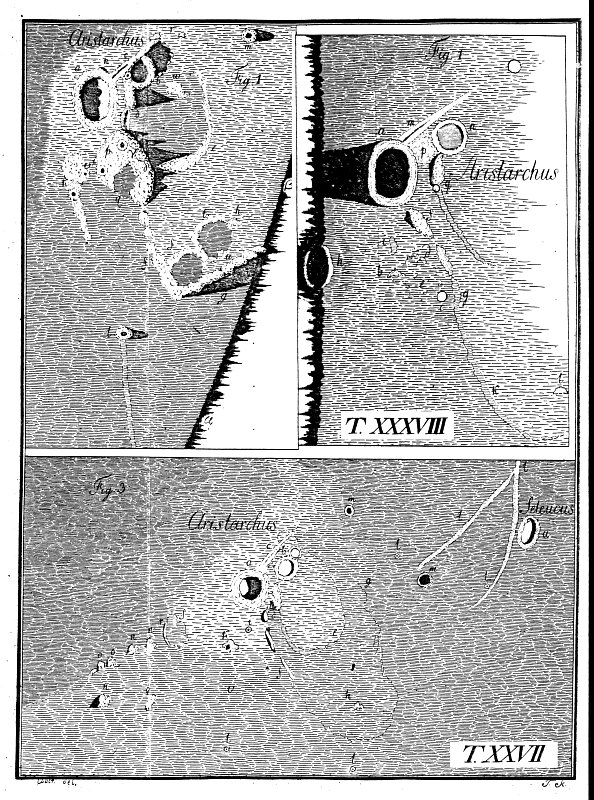
For fourteen years (1787 to 1801), J. H. Schroeter observed the Earth’s moon before his two-volume lunar work was ready for print. He sketched plains, craters, grooves, and mountains, determined their diameters, lengths, and depths, and contemplated the history of the Moon’s formation.
Schroeter recognized that both volcanic and tectonic forces had shaped the Moon’s surface, that there were terrains of different ages, and that the lunar ground must have varying consistencies. He believed that the Moon had a thin atmosphere and that valleys and grooves could be flourishing landscapes inhabited by beings he called “Selenites.”
The “Selenotopographische Fragmente”, with more than a thousand pages of text and seventy-five copper-engraved drawings, gained widespread recognition and established Schroeter’s worldwide reputation as a lunar researcher.
Diagrams of solar and lunar eclipses, the formation of lunar phases, crater and mountain measurements based on shadow lengths, and the determination of crater, rille, and depression depths under different sunlight conditions precede a detailed description of the lunar surface.
Examples:
Tab. XVI: Crater Archimedes
- “Significant crater wall mountain range – an older, now flattened depression.”
- The crater floor appears gray and completely smooth.
- Archimedes is surrounded by high mountains, headlands, elongated mountain ridges, and both small and large depressions.
- A rille (i), approximately 10 geographical miles long, extends from the crater rim to point h.
- Below Archimedes, a “mountain vein” (fold ridge – r) runs, originating in the northern foothills of Copernicus Crater.
Tab. XXVII: Crater Aristarchus
- J. H. Schroeter describes the crater as a “layered ring mountain.”
- Like many observers after him, he noted brightness variations within the crater, attributing them to highly reflective lunar material.
- The 140 km-long “bent rille” (e), originating from the smaller adjacent crater Herodotus (b), was named “Schroeter Valley” or “Schroeter Rille” following the nomenclature introduced by Schroeter.
Observation Instruments (1 foot ≈ 30 cm focal length):
- 4- and 7-foot reflectors based on Herschel (Selenotopographische Fragmente Part I)
- 7- and 13-foot Newtonian reflectors by Schrader/Schroeter
- 15- and 27-foot reflectors by Schroeter
Co-observers of J.H. Schroeter:
- From Lilienthal: Karl Ludwig Harding, Friedrich Wilhelm Bessel
H. J. Leue (translated)
Example: Mercury und Venus
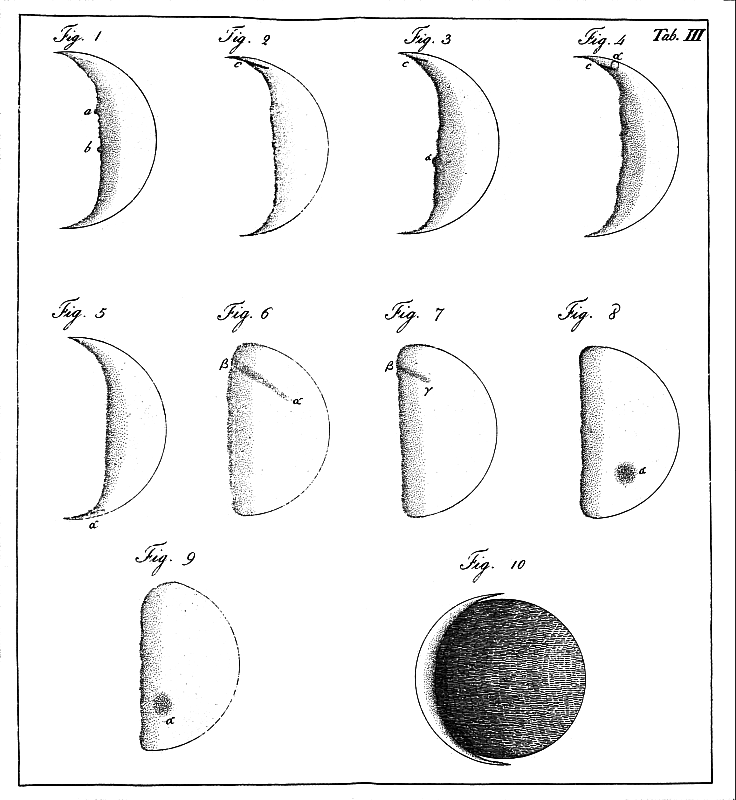
The planets Mercury and Venus are typically visible as morning or evening stars, close to the horizon during twilight. Starting around 1800, J.H. Schroeter and Karl Ludwig Harding observed these two inner planets frequently during the day using a 10-foot refractor. This approach reduced the challenges of observing surface details due to increased atmospheric turbulence near the horizon and provided a longer duration of visibility.
Mercury, due to its small size, posed a particular challenge; prior to Schroeter, only sporadic dark areas were spotted on its surface. On Venus, which is always cloud-covered, even modern telescopes reveal only blurred spots and streaks. It wasn’t until the arrival of numerous space probes that concrete information about the planets’ surfaces, atmospheres, and rotational periods became available.
Observation times:
- Mercury: 1800 – 1802
- Venus: 1784 – 1806
Observation instruments (1 foot ≈ 30 cm focal length):
- 1779 – 1784: 3-foot achromatic refractor
- From 1784: 4-foot Newton reflector after Herschel
- From 1786: 7-foot Newton reflector after Herschel
- From 1800: 10-foot refractor by Dollond
Co-observers of J.H. Schroeter:
- From Lilienthal: Karl Ludwig Harding
Observation results:
- The planet Mercury shows stripes and spots on its surface (Tab. II – Fig. 17-32)
- The planet Venus shows spots at the shadow boundary (Tab. III – Fig. 1: a/b – Fig. 3: ())
- The surface has spots and stripes (Tab. III – Fig. 4, 8/9: ( – Fig. 6: (/( – Fig. 7: (/ ())
- Venus has “ash-gray” light on the dark side (Tab. III – Fig. 10)
Conclusions:
- The surface of Mercury has mountains, mountain ranges, valleys, and plains
- The highest mountains are located on the southern hemisphere
- Mercury has an atmosphere
- The stripes are atmospheric phenomena and clouds moving in an east-west direction
- Mercury has a short rotation period
- The shadows at the Venus terminator are mountains or “chain mountains”
- Venus has a dense atmosphere
- The shadows on the surface are clouds with internal movement
- The rapid changes in spots suggest a fast rotation
- The ash-gray light is produced by aurora-like phenomena in the atmosphere
H.J. Leue (translated)
Example: Mars
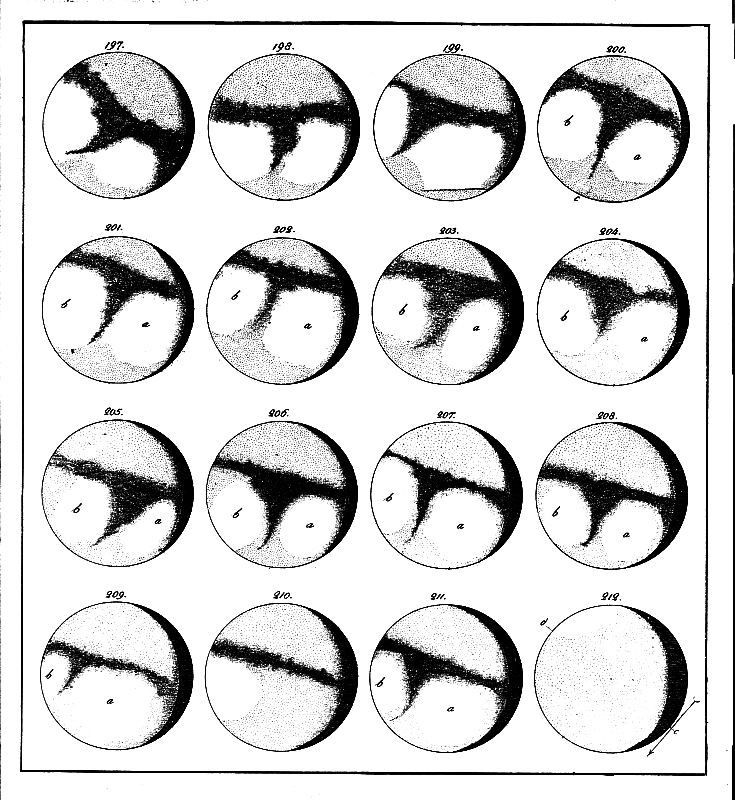
J.H. Schroeter’s observations of Mars were only published 65 years after his death, in 1881, under the title “Areographische Beyträge zur genauern Kenntnis und Beurtheilung des Planeten Mars” on behalf of the Leiden Observatory. Due to its small size, the neighboring planet is a challenging object to observe. Therefore, J.H. Schroeter’s results on changes on the planet’s disk and its topography—documented through 230 drawings from the period between November 1785 and January 1802—are particularly fascinating. It was only with in-situ observations by space probes that some of the conclusions Schroeter had drawn were confirmed. The descriptions of the conditions—whether it was the harsh observational circumstances during cold winters or the observation of surface details by his 12-year-old son Johann-Friedrich, who independently observed with the 7-foot Herschel reflector—provide the reader with the image of an engaged observer.
Observation times:
- 1785 to 1798 and 1800 to 1803
- Fig. 197 to Fig. 212: December 8, 1800 to April 14, 1801
Observation instruments (1 foot ≈ 30 cm focal length):
- 4- and 7-foot Newton reflectors based on Herschel’s design
- 7- and 13-foot Newton reflectors by Schrader
- 20- and 27-foot Newton reflectors by Schroeter
- 10-foot refractor by Dollond
Co-observer of J.H. Schroeter:
- From Lilienthal: Johann-Friedrich Schroeter / Karl-Ludwig Harding / Georg Tischbein
- From Bremen: Wilhelm-Mathias Olbers
- From Hanover: Mechanic Drechsler
- From Gotha: Franz-Xaver von Zach
- From Celle: Ferdinand von Ende
Observation results:
- There are mountains and mountain ranges – the highest ones are located on the southern hemisphere of the planet.
- Spots and streaks are temporally variable and suggest the presence of clouds.
- Mars has two polar regions that change in size and color with the seasons.
Conclusions:
- The gray and bright spots could be clouds.
- The Sun has an influence on the formation of the spots.
- There are strong winds in the east-west direction, which die down towards the night.
- Mars has an Earth-like atmosphere with weather formation – it is the most Earth-like of the planets in the solar system.
H.J. Leue (translated)
Example: Jupiter
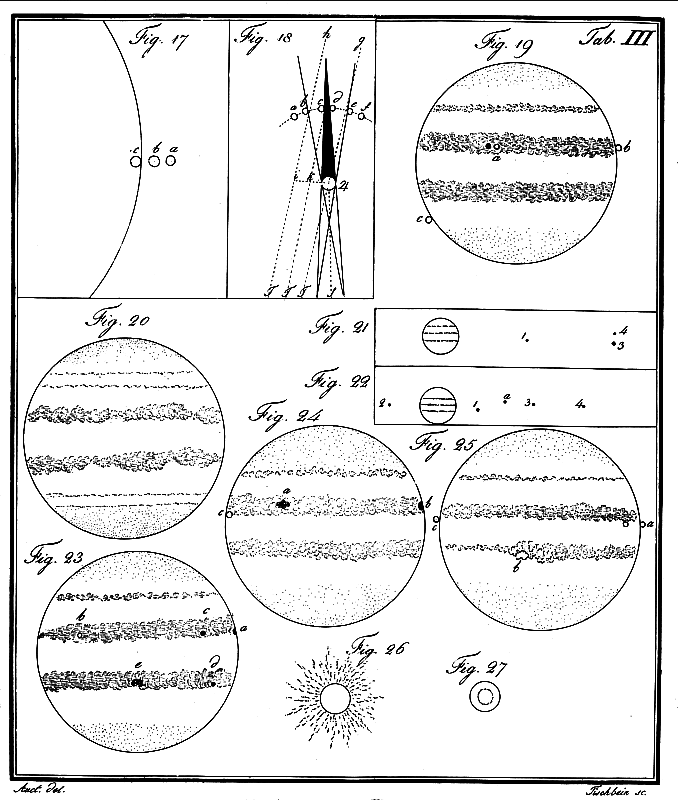
On Jupiter, the largest planet in the solar system, two prominent cloud bands near the equator and the four bright moons – the so-called Galilean moons – are clearly visible even with small hand-held telescopes.
J.H. Schroeter’s observations from 1785 to 1787 with short focal length telescopes show little detail in the cloud formations. Only with the use of his larger and optically improved instruments, which were primarily employed for studying the Jupiter moons in 1796/97, was he able to observe the dynamics of the bands, their color changes, the sporadic formation and alteration of individual spots, as well as the fine stripes in the polar regions. The light variations of the two inner moons led Schroeter to suspect that they have a distinct topography and atmosphere.
J.H. Schroeter determined the diameter of Jupiter, including its flattening, as well as its rotation period. From the four bright moons, he determined the visibility parameters (Tab. III – Fig. 17/18), tracked their shadows on the planet’s surface (Tab. III – Fig. 19 and Fig. 23), and attempted to measure their diameters and rotation periods.
Observation times:
- October 1785 to November 1787
- August 1796 to December 1797
Observation instruments: (1 foot ≈ 30 cm focal length)
- 4- and 7-foot Newton reflectors according to Herschel
- 7- and 13-foot Newton reflectors by Schrader/Schroeter
- 27-foot Newton reflector by Schroeter
Co-observer of J.H. Schroeter:
- From Lilienthal: Karl-Ludwig Harding
Observation results:
- The cloud bands run parallel to the planet’s equator.
- They move from west to east.
- The bands have their own dynamics with forward and backward movements.
Bright and dark spots of different sizes sporadically appear in the bands (Tab. III – Fig. 23). - The cloud bands and spots undergo color changes.
- In the grayish polar regions, fine parallel cloud streaks can be observed.
- Jupiter shows a strong light drop towards the edge.
- The two inner moons show spots and changes in brightness.
Conclusions:
- Jupiter has a dense atmosphere with high wind speeds.
- The spots are zones of varying cloud density and height.
- The spots on the moons could be cloud formations.
- Due to its large mass, Jupiter has a strong influence on the inner moons.
H.J. Leue (translated)
Example: Saturn
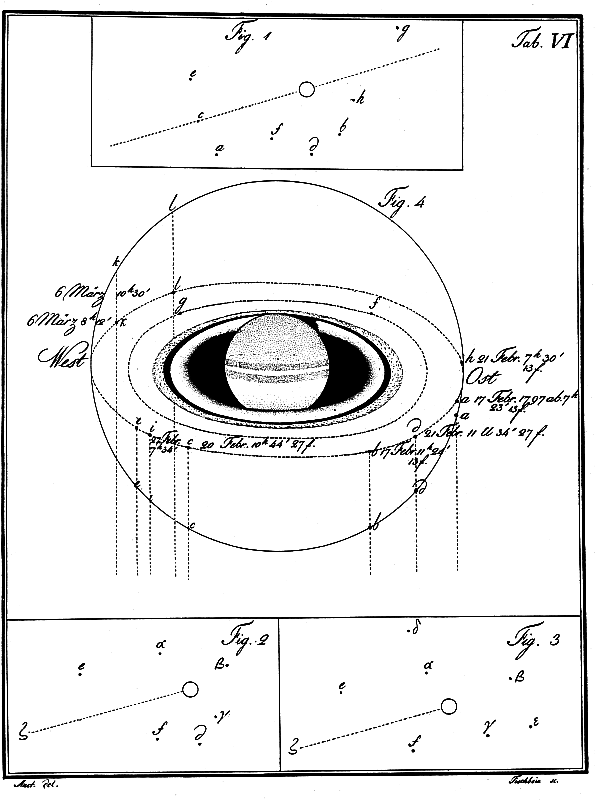
Until 1781, when Wilhelm Herschel discovered the planet Uranus with a self-made telescope, Saturn was considered the outermost planet of the solar system.
After the invention of the telescope, it became clear that Saturn did not appear as a round disk. It was often depicted as a “handle-like” shape.
Only the optically improved telescopes of the 18th century revealed details of the rings, such as their division, and allowed for speculation about the morphology of the ring system.
J.G. Schrader and J.H. Schroeter used observations of Saturn to assess the optical performance of the telescope mirrors they had ground. The observation of a total of seven Saturn moons down to the 13th magnitude by J.H. Schroeter and K.L. Harding is an impressive proof of the quality of their instruments.
Schroeter determined the planet’s rotation period, its diameter, the dimensions of the ring system, and the orbital periods of some of Saturn’s moons. Karl-Ludwig Harding discovered “nodes” in Saturn’s ring plane, which led Schroeter to refer to them as the “Harding Mountains.”
While observing Saturn’s moons, Harding and Schroeter were also able to identify some moons of the planet Uranus, which was still referred to as “fidus Georgium” at the time, in February 1797 (Tab VI / Fig. 1 to 3).
Observation periods:
- June 1789 to February 1804
Observation instruments (1 foot ≈ 30 cm focal length):
- 7- and 13-foot Newton reflectors by Schrader/Schroeter
- 27-foot Newton reflector by Schroeter
Co-observers with J.H. Schroeter:
- From Kiel: J.G. Schrader
- From Lilienthal: Karl-Ludwig Harding
Observation results:
- The ring and the planet are not connected – the space between them is empty.
- The ring lies in the equatorial plane of the planet.
- The ring has varying thicknesses with embedded nodes.
- The nodes are still visible even when the ring is in edge-on position.
- The ring casts a shadow on the planet.
- The ring is divided and has varying reflection properties.
- The Saturnian atmosphere is similar to that of Jupiter.
- Saturn has parallel cloud bands with embedded spots.
Conclusions:
- The ring consists of small and large fragments of matter.
- The “chaotic” ring matter is held together by Saturn’s gravitational forces.
- Moons could have formed from the ring material.
H.J. Leue (translated)
Examples: Planetoids Ceres, Pallas, Juno, Vesta
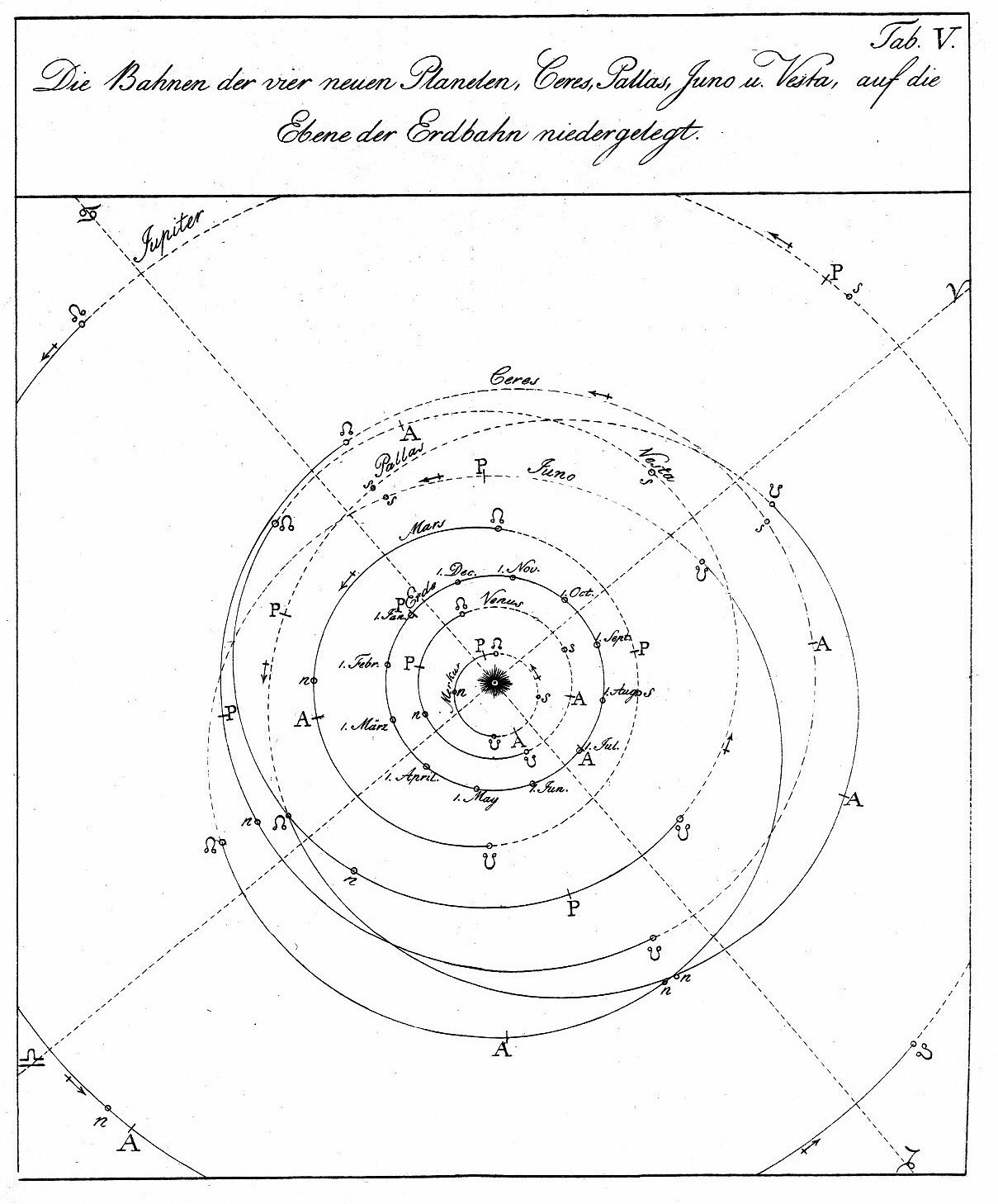
Whether the founding of the Lilienthal Society on September 20, 1800, for the purpose of finding the suspected planet between Mars and Jupiter, had a decisive influence on the discovery of the four asteroids remains controversial. It is also not certain whether the discovery of the first asteroid, Ceres – named after the goddess of growth – in 1801 by Joseph Piazzi in Palermo was due to the systematic search according to the statutes of the Lilienthal Society. This is because it was only after orbital calculations that Piazzi’s belief, that his newly discovered object was a small comet, was disproven. It is well documented that the Gotha astronomer and initiator of the Lilienthal Association’s founding, Franz Xaver von Zach, firmly believed in the validity of the Titius-Bode law. This orbital distance law stated that there must be a planet between Mars and Jupiter, which was the object of search at the time.
After Wilhelm Mathias Olbers discovered the second small planet in 1802 on a Ceres-like orbit — it was named Pallas — he was convinced that a “shattered planet” had left behind several fragments in the form of the discovered objects. Karl Ludwig Harding postulated that more small planets could be found at the intersections of their orbits. His persistent observations led to success in September 1804. With Schroeter’s telescopes, he discovered the third planetoid, which was named after the ancient Italian goddess of marriage, Juno.
After the discovery of the fourth object, Vesta, again by Olbers, J.H. Schroeter wrote: “Instead of the predicted eighth major planet, as experience now convinces us and as far as discoveries have progressed so far, the almighty has developed and formed four small planets from the chaotic matter.”
Discovery dates:
- Ceres – January 1, 1801 by Joseph Piazzi in Palermo
- Pallas – March 28, 1802 by Wilhelm Mathias Olbers in Bremen
- Juno – September 2, 1804 by Karl Ludwig Harding in Lilienthal
- Vesta – March 29, 1807 by Wilhelm Mathias Olbers in Bremen
The Lilienthal astronomers, with Friedrich Wilhelm Bessel representing positional astronomy, tracked the paths of the small celestial bodies and determined their positions, which they forwarded to Karl-Friedrich Gauss in Göttingen for newer, more accurate orbital calculations (Tab. V).
In addition to orbital mechanics, Schroeter was interested in the physical properties of the bodies, which he referred to as asteroid-planets. He determined their diameters and attempted to correlate the different values with their orbital diameters. While Ceres, Pallas, and Juno appeared as small discs in the telescope and glowed in the calm light of planets, the small Vesta appeared as a fixed star. Schroeter suspected that Vesta not only reflected sunlight but, at least in one phase of development, emitted its own light. The weak light variations of the other planetoids he attributed to the self-rotation of irregular bodies; the differing orbital eccentricities he explained with the mutual perturbations of the planetoids.
Schroeter expressed their common origin with the words: “It seems to me, through these previously mentioned circumstances, that Ceres, Pallas, Juno, and Vesta are proof of themselves, that they are sister bodies of a simultaneous birth.”
H.J. Leue (translated)
Example: Comets
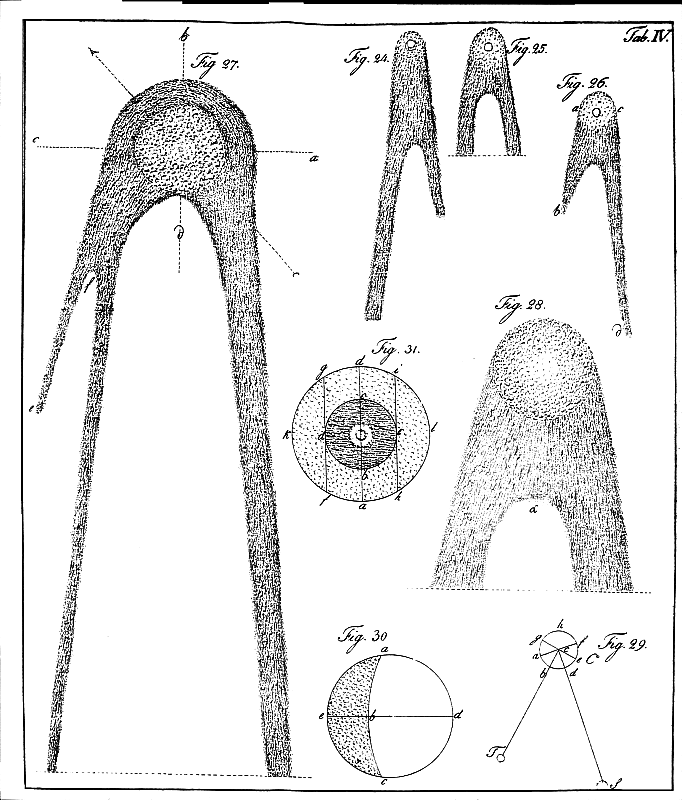
In the geocentric worldview of the Middle Ages, comets did not belong to the heavenly sphere – they were seen as harbingers of doom, as a punishment from God. During Schroeter’s time, it was known that comets moved along orbits that extended to the outer boundaries of the solar system. However, the chemical and physical processes that shape the appearance of these sporadically appearing celestial bodies when they are near the Sun were still not understood.
It wasn’t until the 1986 Giotto mission to Halley’s Comet that the size of a comet’s nucleus could be determined, its morphology studied, and the emission of gas and dust particles analyzed as an interaction with the solar wind. Some of Schroeter’s hypothetical conclusions were confirmed during this mission.
The two comets of 1807 and 1811 were very bright, with tail lengths of approximately 10 and 16 degrees.
Observation times:
- Comet of 1807: October 4, 1807, to February 24, 1808 – Tab. I
- Comet of 1811: August 25, 1811, to December 18, 1811 – Tab. IV
Observation instruments: (1 foot ≈ 30 cm focal length)
- 3.5-inch comet seeker by Weickert
- 7- and 15-foot Newton reflectors by Schrader/Schroeter
- 10-foot refractor by Dollond
Co-observers of J.H. Schroeter:
- From Göttingen: Karl Ludwig Harding
- From Lilienthal: Friedrich Wilhelm Bessel
- From Bremen: Wilhelm Mathias Olbers
Observation results:
- The tail is directed away from the Sun.
- It can become several million kilometers long.
- Comets often have multiple tail branches of different lengths and curvatures.
- The tail material is so finely distributed that stars can be seen through it.
- Tails can pulsate—changing rapidly in brightness and expansion.
- The head region (coma) varies in brightness, expansion, and condensation.
- The “head veil” is sometimes ejected—the “light fog” transitions into the tail.
Conclusions:
- The Sun drives the tail material into space.
- Comets have a small core of low mass—solid and/or liquid.
- The core is surrounded by an “atmosphere” or “light shell.”
- The core is hidden from observation because it is overshadowed by the brightness of the coma.
- Comets generate their “own” light—they hardly reflect sunlight.
- The ejection of material from the core is based on “terrestrial electricity” and “galvanism.”
- The repulsive force is present throughout space.
H.J. Leue (translated)