


History of Astronomy in Lilienthal
In the late 18th century, astronomy, as often in its history, was undergoing a period of transformation.
On March 13, 1781, Friedrich Wilhelm Herschel (1738 – 1822)
In England, on March 13, 1781, Friedrich Wilhelm Herschel (1738 – 1822) discovered the planet Uranus with a self-built reflecting telescope. This nearly doubled the boundaries of the visible solar system.
Herschel was the one who perfected the construction of reflecting telescopes; he cast, ground, and polished metal mirrors. For his large reflecting telescopes, Herschel developed a practical mount that remained a model for azimuthal telescope mounting for a long time.
Many observatories were founded across Europe and equipped with powerful refracting and reflecting telescopes, which not only enabled topographical observations of the Moon and planets but also revealed details in galactic nebulae and star clusters, as well as large-scale structures in galaxies.
Astronomical measurement techniques were still in their infancy and could not keep pace with advanced mathematics, so ideas about the dynamics of galaxies and their integration into cosmogonical questions remained speculative.
Even accurate distance measurements to the fixed stars in the nearby solar neighborhood were not possible. Disciplines like astrophysics or planetary exploration were only discernible in sporadic attempts.
The determination of the positions of celestial bodies in the solar system and their orbital calculations were at the forefront of the efforts.
At the turn of the 18th to the 19th century, Lilienthal and Bremen were centers of astronomy of international significance. Johann Hieronymus Schroeter in Lilienthal and Wilhelm Matthias Olbers in Bremen provided crucial impulses for the astronomy of the 19th century.
- H. Schroeter is considered the founder of modern selenotopography, the science dedicated to the study of the lunar surface. With his long-term and intensive observations of the moons of the solar system, he initiated a new astronomical discipline – telescopic planetary exploration.
The Lilienthal Observatory, as the largest observatory on the European continent, was, along with the development of new technologies for manufacturing telescope mirrors, synonymous with research and technology.
Astronomy history was made in Lilienthal. Karl-Ludwig Harding discovered the minor planet JUNO with a telescope from the Lilienthal Observatory. Friedrich Wilhelm Bessel spent his “apprenticeship” as an inspector at Schroeter’s observatory.
With the founding of the Lilienthal Society in 1800, aimed at the discovery of the suspected planet between the orbits of Mars and Jupiter, the first astronomical association with a specific goal was established in Lilienthal. The collaboration of 24 astronomers from nine European countries was a project of European dimension during the era of small states and the Napoleonic Wars.
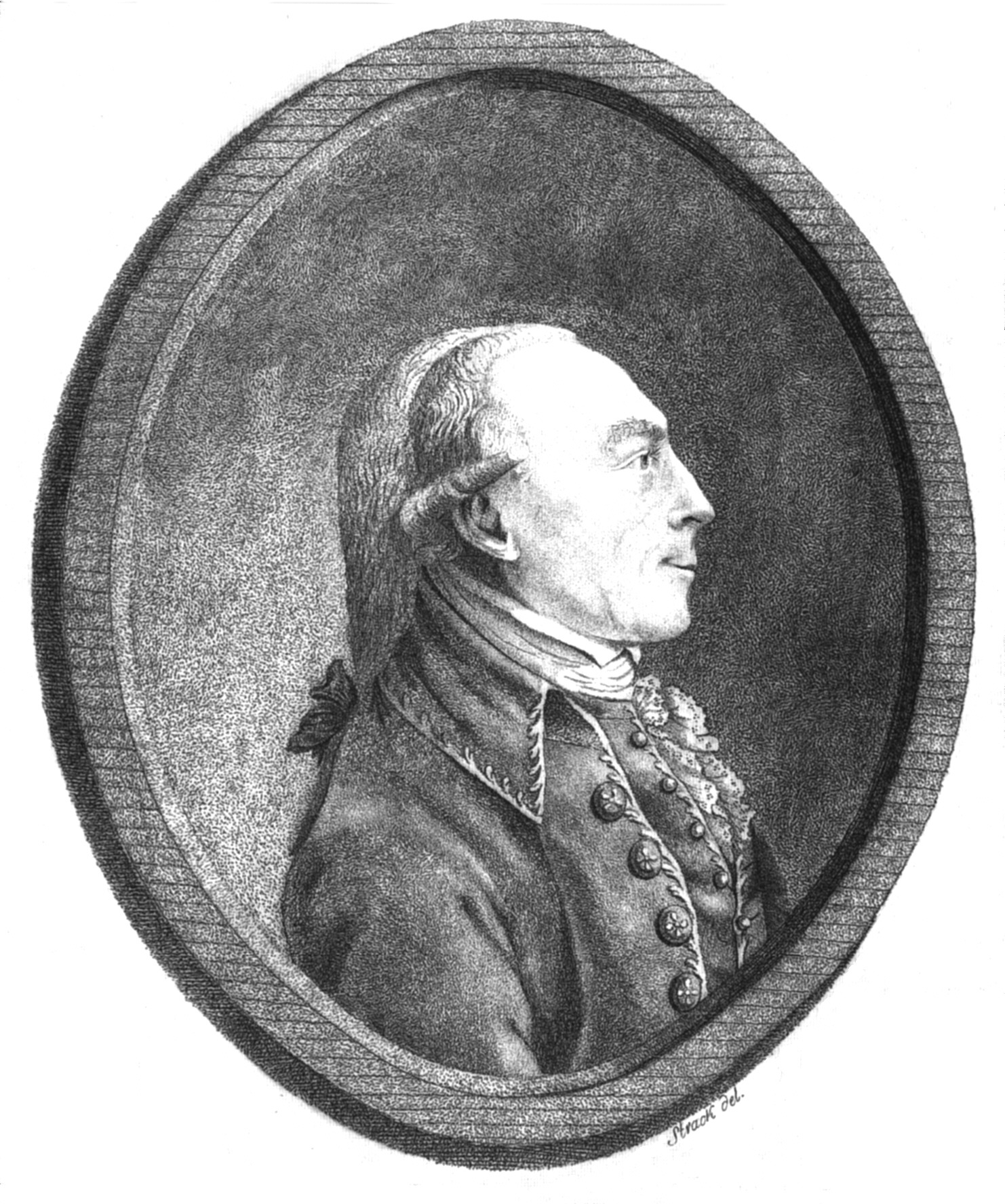
Johann Hieronymus Schroeter (born August 30, 1745, in Erfurt, died August 29, 1816, in Lilienthal)
After school, Schroeter studied theology in Erfurt, then law in Göttingen. There, he met G.C. Lichtenberg and attended G.E. Kästner’s lectures on astronomy. In 1770, Schroeter was employed as an auditor at the Herzberg office in the Harz Mountains; in 1775, he became a clerk in Polle on the Weser, and from 1777, he worked as a chamber secretary in Hannover, where he met the Herschel family.
Schroeter’s serious engagement with astronomy began in 1779 when he acquired a 3-foot refractor from the renowned English optician Dollond, with which he conducted observations of the Sun, Moon, and planets.
In May 1782, Schroeter became the bailiff in Lilienthal.
The expansion of the solar system with the 7th major planet and the ability to make such discoveries with self-built telescopes, as demonstrated by Wilhelm Herschel in March 1781 with the discovery of the planet Uranus, served as motivation for Schroeter to build his first observatory, called Uranienlust, in 1785.
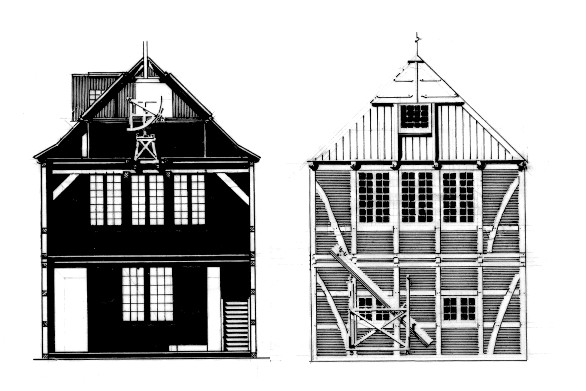
Uranienlust Observatory – Reconstruction by Dr.-Ing. Felix Lühning
The small observatory is equipped with a 4-foot and a 7-foot Herschel reflector telescope. Schroeter obtains the mirrors and mechanical parts from Herschel, while he builds the mounts himself.
Schroeter’s moon observations from these early years form the foundation for his two-volume work Selenotopographical Fragments, the first part of which was published in 1791, and the second in 1802, making Schroeter famous as one of the leading lunar researchers of his time.
The Lilienthal telescope construction receives its crucial impulses from the approximately one-year stay of the Kiel professor of physics and chemistry J.G.F. Schrader in 1792/93. In addition to commissioned work, including for the Bremen Museum Society, several 7-foot reflectors, Schroeter’s 13-foot telescope, and the first of two mirrors for the 27-foot telescope are created.
The telescope is erected in 1793 in the municipal garden behind the St. Marien Monastery Church, making it the largest instrument of its kind on the European mainland. It is also referred to as the Second Observatory.
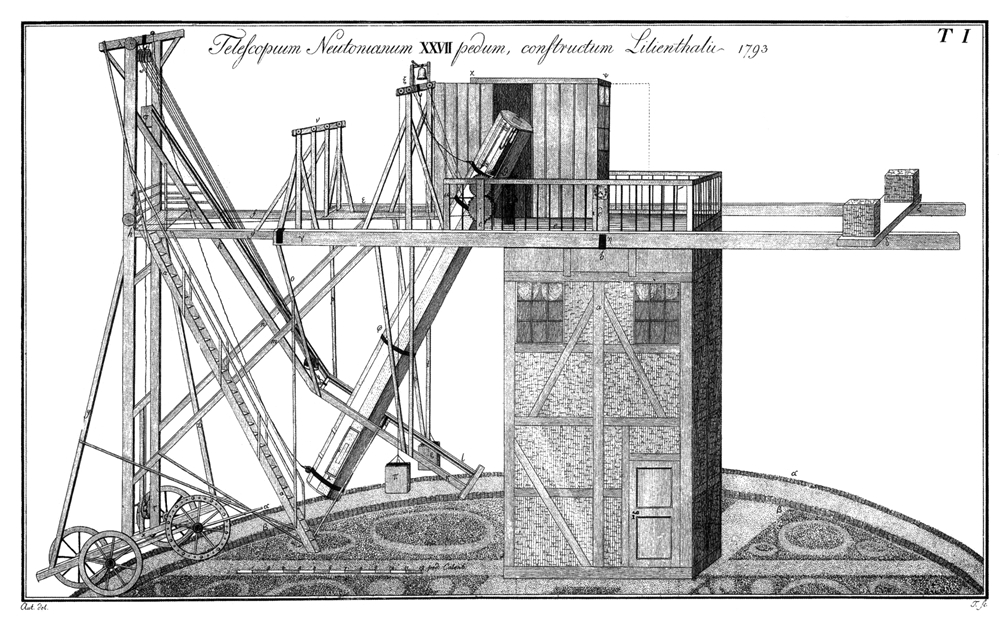
Drawing by J.H. Schroeter from the year 1793
Harm Gefken (1756–1811), the municipal gardener and observatory caretaker, born in Lilienthal-Trupe, assisted Schrader with the casting, grinding, and polishing of metal mirrors. Following in Schrader’s footsteps, Gefken also went on to fabricate complete reflecting telescopes in the following years, including for the Duke of Oldenburg.
The Lilienthal Observatory is gaining increasing international recognition, as it continues to produce new and spectacular observations of the Moon and planets. The number of renowned visitors and guest observers is steadily growing. Schroeter’s publications—by the end of his life numbering more than 100 technical descriptions on telescope and instrument construction, as well as detailed treatises on the Sun, the Moon, and the planets with their moons—are now widely distributed across Europe.
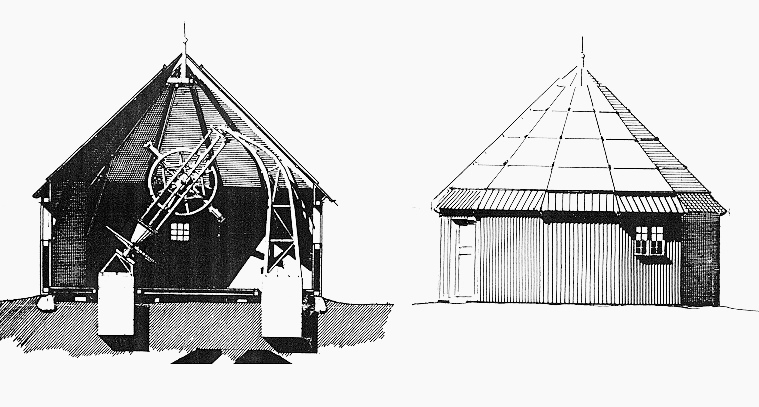
Urania Temple – Reconstruction by Dr.-Ing. Felix Lühning
In 1795, the observatory complex was expanded with the construction of the so-called Urania Temple—also known as the Third Observatory—and equipped with a 10-foot refracting telescope by Dollond, primarily for observing the planets Venus and Mercury.
In 1807, the Lilienthal Observatory reached its peak expansion with the construction of a free-standing 20-foot reflecting telescope. At least 10 different telescopes of varying sizes were available to observers.
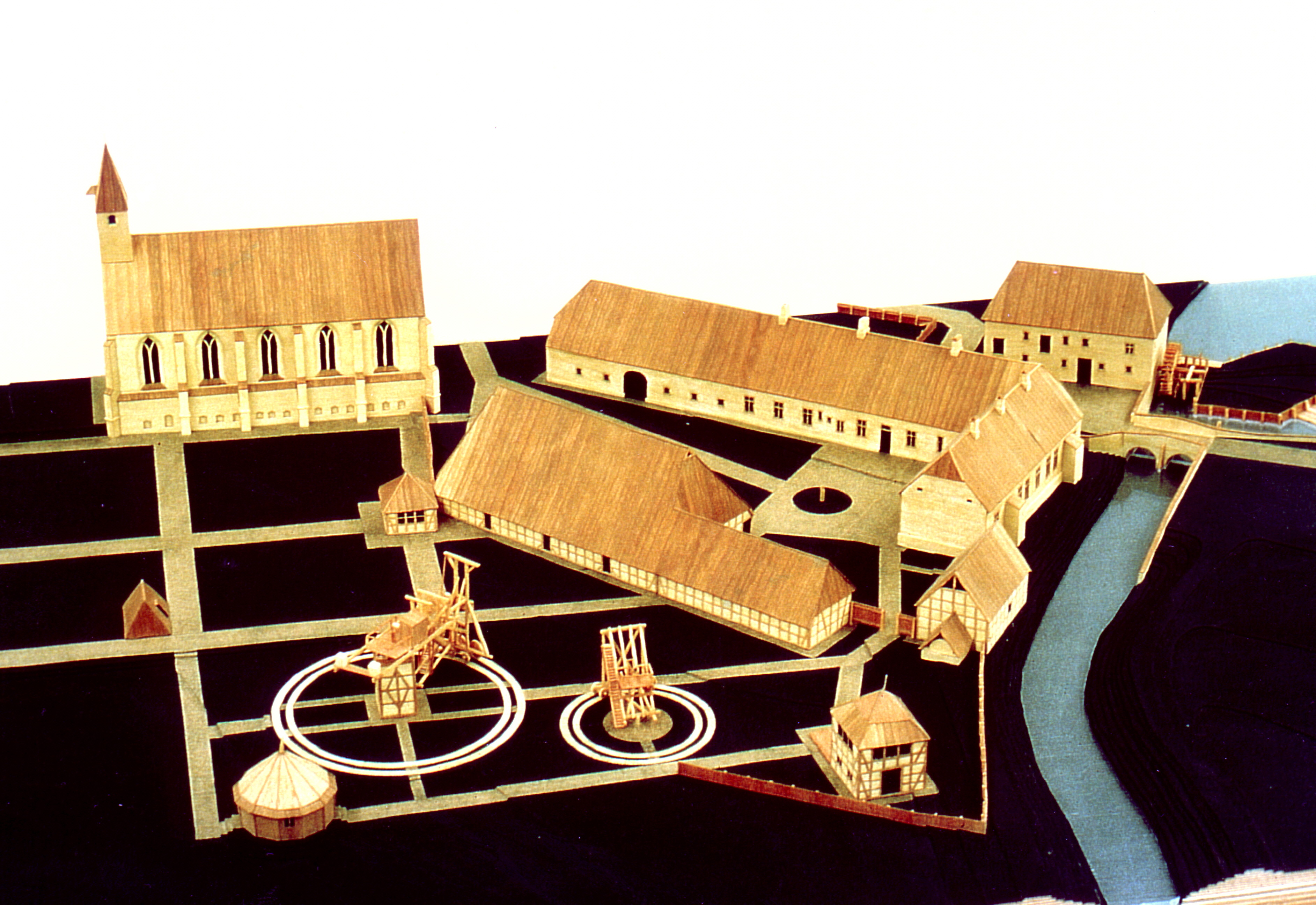
Amtshof – Reconstruction and photo by Dr.-Ing. Felix Lühning
Schroeter corresponds with many astronomers; some of them, such as Gauss, Chladni, von Zach, von Lindenau, and von Ende, visit the Lilienthal administrative house.
Wilhelm Olbers from Bremen often stays for days and weeks as a guest and co-observer at Schroeter’s observatory.
On June 15, 1786, Schroeter’s only child, his son Johann Friedrich, was born from his “lifetime Christian marriage,” as stated in his will from May 1813, to Ahlke Lanckenau from Oberende.
Johann Friedrich did not develop significant astronomical ambitions. He became a lawyer and died as a retired civil servant in August 1850 in Lilienthal.
In 1796, Karl Ludwig Harding came to Lilienthal as a tutor for Schroeter’s son. Harding had already made scientifically grounded astronomical observations in Lauenburg on the Elbe and therefore took over the position of observatory inspector.
On September 21, 1800, the Astronomical Society was founded on the initiative of the Gotha astronomer Franz Xaver von Zach during his journey to Bremen and Lilienthal. It is also known as the Lilienthal Society of 1800.
The assembly of astronomers and geodesists elected Schroeter as the first president of this working group.
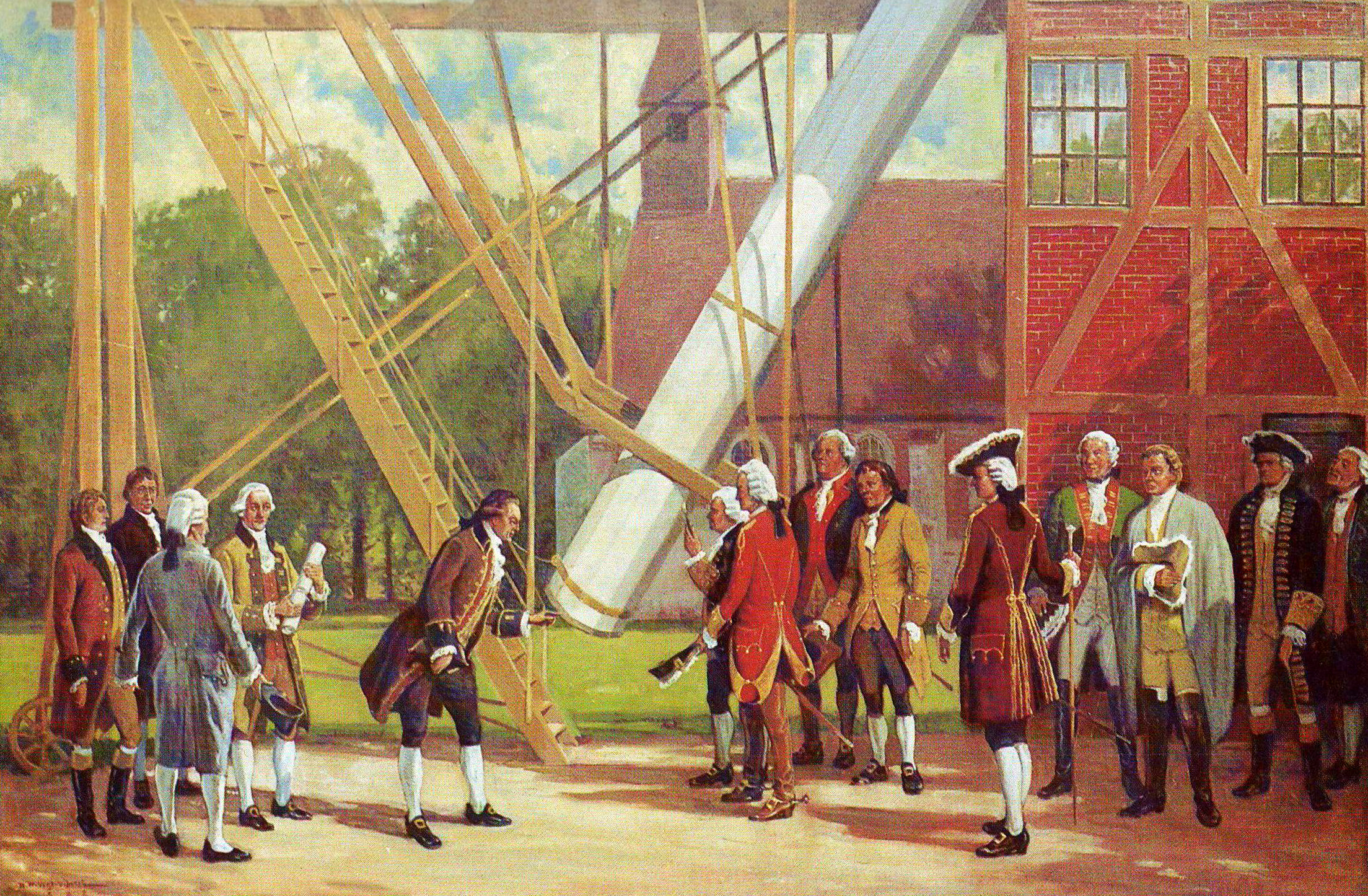
Painting by H.W. Vogt-Vilseck 1988
Von Zach firmly believed in the rule established by astronomers Titius and Bode, according to which the orbital distances of the planets follow a regular pattern. According to this, there was a missing celestial body between the orbits of Mars and Jupiter.
Von Zach had recruited 24 European astronomers to observe a designated area of the zodiac in order to find the still undiscovered planet.
Instead, the members of the society discovered four small planets — also called planetoids or asteroids — within six years:
1801, CERES by Piazzi in Palermo;
1802, PALLAS by Olbers in Bremen;
1804, JUNO by Harding in Lilienthal;
1807, VESTA by Olbers in Bremen.
The great success of the astronomical association is not only explained by the consistent observational activities of Olbers, von Zach, and the Lilienthal astronomers.
The coincidental alignment of the planetoids, combined with the method developed by Carl Friedrich Gauss (1777–1855) for calculating specific orbital parameters, contributed significantly to the success!
In 1805, Harding received an appointment as a professor of astronomy at the newly built observatory in Göttingen, where Gauss was to become the director.
The position of observatory inspector in Lilienthal was filled in 1806 by Friedrich Wilhelm Bessel, who, on the advice of Olbers, had abandoned a well-paid apprenticeship and employment as a merchant in Bremen.
During his time in Lilienthal, Bessel focused primarily on calculating and analyzing cometary orbits in addition to observing minor planets. After his departure from Lilienthal to Königsberg in 1810, Schroeter’s observatory became increasingly deserted.
Schroeter’s final years were occupied with urgent administrative duties, a period without official responsibilities, the publication of his Mercury observations, and preparatory work for printing his long-term Mars observations.
During the retreat of the French troops, Lilienthal was almost completely burned down in April 1813. Schroeter’s observatory remained intact, except for some looting.
The reconstruction of the Amtshaus and the town of Lilienthal demanded a great deal of effort and time from Schroeter, preventing him from publishing his Mars observations. These were later edited and published in 1881 by the Leiden Observatory in response to Schiaparelli’s supposed discovery of Martian canals.
On August 29, 1816, one day before his birthday, Schroeter passed away after suffering a stroke. The remaining telescopes were transferred to the Göttingen Observatory by Harding, as per contractual agreement.
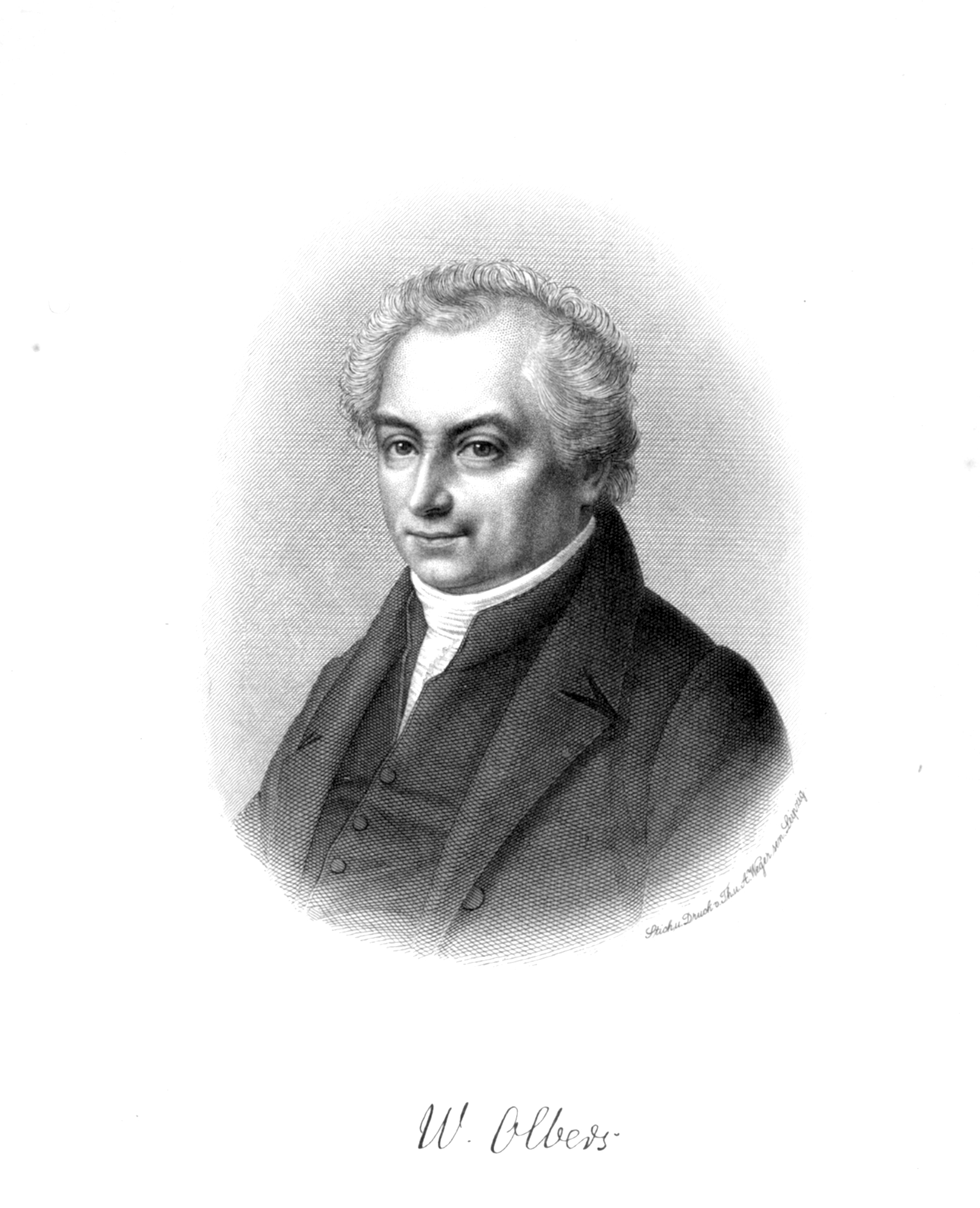
Heinrich Wilhelm Matthias Olbers (born October 11, 1758, in Arbergen near Bremen, died March 2, 1840, in Bremen).
Even during his medical studies in Göttingen, Olbers conducted astronomical research on comets. “Comet astronomy has always been my favorite subject,” he wrote in 1791 about his passion.
Since 1782, Olbers has been working as a physician in Bremen. Later, he builds a small astronomical observation station in the bay windows of his house on Sandstraße behind Bremen Cathedral, equipped with portable refracting telescopes by Dollond and Fraunhofer. His visits to Lilienthal begin in November 1789 and end in 1809. His relationship with Schroeter is one of friendship, medical advice, assistance, and critique in mathematical calculations and the evaluation of observational results.
In April 1813, he takes in Schroeter, who had fled after the Lilienthal fire, into his home.
Olbers becomes a founding member of the Lilienthal Society of 1800. In 1802 and 1807, Olbers discovers the asteroids PALLAS and VESTA in Bremen.
He discovers several comets, provides essential insights for modern comet astronomy, and develops a new method for calculating the orbits of these celestial bodies, which is still used today.
His extensive correspondence, publications, and lectures in the Bremen Museum Society promoted the intensive, Europe-wide collaboration of astronomers of his time.
Under the title On the Transparency of Space, he redefined the cosmological phenomenon of the darkness of the night sky.
It became known as Olbers’ Paradox in history and could only be explained by modern physics and astronomy.
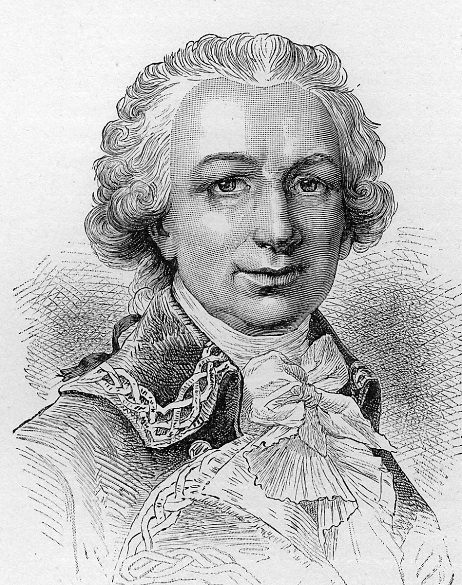
Karl-Ludwig Harding (born September 29, 1765, in Hamburg, died August 31, 1834, in Göttingen).
Harding is the son of a preacher in Lauenburg on the Elbe. From 1786, he studied theology in Göttingen. Through his friendship with G.C. Lichtenberg, he became interested in astronomy and also met J.H. Schroeter through him. Initially only visiting, from July 1796 onward, Harding took on the position of observer and observatory inspector in Lilienthal and also taught Schroeter’s son Johann-Friedrich.
Harding’s relationship with Schroeter is described by a chronicler as warm and cordial. Schroeter’s records depict him as an indefatigable telescope observer. He is also a founding member of the Lilienthal Society of 1800.
On September 1, 1804, Harding discovered the third asteroid, which he named JUNO. His self-designed star charts, which he compiled into a celestial atlas, Atlas Novus Coelestis, in 1827, were likely a decisive help in the discovery.
A year later, Harding received an offer as an extraordinary professor of astronomy in Göttingen. Olbers and Gauss persuaded Harding to leave his beloved Lilienthal.
During his time in Lilienthal, he wrote 12 papers on comets, planets, asteroids, and geographical measurements.
In 1812, he became a full professor of philosophy, a position he held until his death.
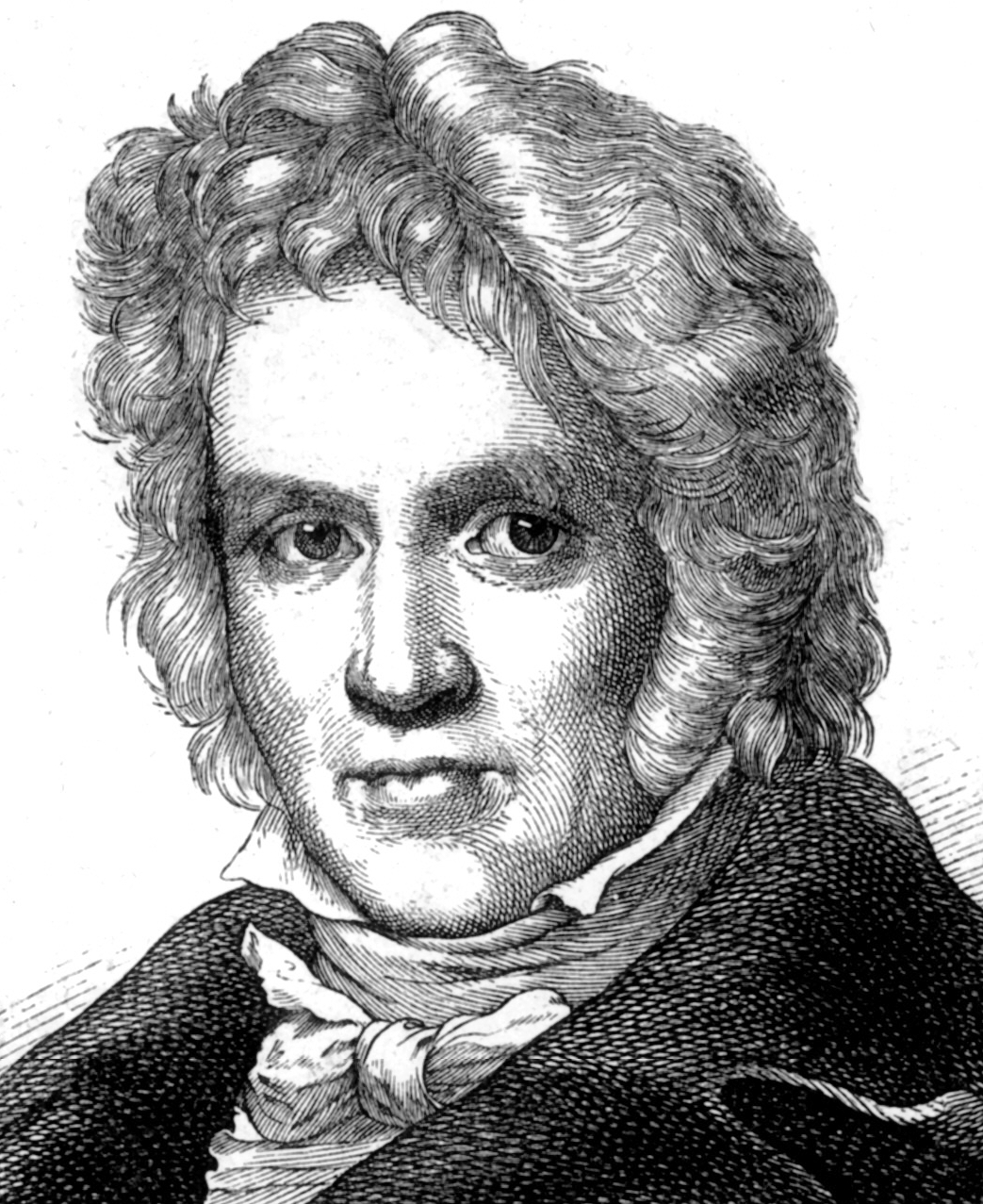
Friedrich Wilhelm Bessel (born July 22, 1784, in Minden, died March 17, 1846, in Königsberg)
Bessel left the gymnasium in Minden during the lower secondary school years because he struggled with the Latin language. Through a recommendation, he received an apprenticeship in 1799 at the trading company Kulenkamp & Söhne in Bremen. There, Bessel learned English and, in his free time, became involved with navigation at the newly founded School of Navigation, which eventually led him to astronomy.
Bessel’s revision of the observational data of Halley’s comet from 1607 made such a strong impression on Wilhelm Olbers, who was at the zenith of his recognition as an astronomer in Bremen, that Bessel assisted him and, starting in 1804, also Gauss with astronomical calculations.
After the vacancy of Harding’s inspector position, Bessel, upon Olbers’ advice, terminates his contract at Kulenkamp in the spring of 1806 and moves to the Amtshof in Lilienthal.
His work with the instruments allows him to quickly make progress in mastering astronomical observation techniques, although Schroeter’s instruments are not suitable for precise measurements. In addition to studying cometary orbits, Bessel increasingly focuses on fixed stars starting in 1807. He feels lonely in Lilienthal and takes up hunting as his second passion.
After four years of service, Bessel bids farewell to Schroeter and his observatory on March 27, 1810. In Königsberg, the self-taught scholar, despite not having a high school diploma, is offered a professorship in astronomy. Before this, the University of Göttingen, under Gauss, confers upon him an honorary doctorate in philosophy.
Bessel’s time in Königsberg is marked by significant achievements in astronomy. He builds a new observatory and produces fundamental works on the Earth’s precession and the obliquity of the ecliptic. In 1837/1838, Bessel, using a newly constructed telescope by the optician Fraunhofer, measures the parallax of the fixed star 61 Cygni with unprecedented precision. Together with Struve in Tartu, he lays the foundations for understanding the spatial distribution of stars in our galaxy. Bessel is also famous for his studies on the proper motion of the fixed stars Sirius and Procyon, caused by companion stars, which are only discovered many years later.
In 1846, Bessel succumbs to colon cancer in Königsberg.
H.J. Leue (translated)